Digital Skills Library · Accounting & Consulting
How to become a freelance bookkeeper
What freelance bookkeepers charge in 2026, the services clients hire for, and the beginner's path from no experience to your first paying client.
Difficulty
2 of 5
No degree or CPA license required, learnable from zero
First dollar
Weeks
A free certification plus steady practice gets most beginners a first client in 4-8 weeks
Startup cost
Low
Free certifications and free partner accounts on QuickBooks and Xero cover day one
AI-friendliness
High
AI handles bulk categorization; you own reconciliation, judgment, and the client relationship
Demand
High & evergreen
Every business that earns money has to track it, in any economy
Start here
Go from curious to freelance-ready
This page shows you what freelance bookkeeping work is like: the pay, the services, and whether it fits you. The full guide inside the Digital Skills Library walks you through getting started: what to learn first, where to learn it, and how to practice until you're ready to offer it as a freelance service. Here's what unlocks for this skill:
- 🔒 A 4-week bookkeeping learning plan: what to learn, in order
- 🔒 Hand-picked certifications and channels, with the why behind every pick
- 🔒 The bookkeeping tools to set up on day one
- 🔒 3 work samples you can build before you have a single client
- 🔒 Ready-to-use AI prompts for everyday client communication
- 🔒 Which skill to add next, and why it raises your freelance rate
- 🔒 The big-picture map: first Upwork job, then better rates, then steady monthly clients
- 🔒 Updates whenever the tools and the market change
The skill, straight
What does a bookkeeper do?
A bookkeeper keeps a business's financial records accurate: categorizing every transaction, reconciling accounts every month, and producing the reports that tell an owner whether they're truly making money. Bookkeeping stops before accounting and tax filing start. A CPA uses the books you keep; you're the one who keeps them clean.
01
Answer the question every owner is afraid to ask
"Are we profitable?" A good bookkeeper answers that every single month, without being asked twice.
02
Remove the shoebox-of-receipts dread
Small-business owners hate the pre-tax-season scramble. They pay you so that moment never happens to them again.
03
Build income that almost never leaves
Switching bookkeepers is a hassle for a business owner, so once you’ve earned their trust, a good client relationship tends to run for years.
Is bookkeeping right for you?
Yes
You’re detail-oriented, you find real satisfaction in getting a number exactly right, and you’re comfortable with numbers even if you’re not a "math person." If you’ve ever been the organized one in the room, you’re already most of the way there.
Maybe
You’re a big-picture, fast-moving type who finds monthly process work tedious. It’s learnable, but be honest with yourself about whether you’ll love doing it month after month.
No
You find financial responsibility stressful. Errors in real books flow downstream into tax returns and real business decisions. That accountability isn’t for everyone, and that’s fine.
Best for detail-oriented organizers, numbers people, ex-corporate finance and ops professionals, and anyone who finds real satisfaction in a clean, reconciled ledger. If you've always kept meticulous personal finances and wondered if that could be a career, it absolutely can.
Pick a lane
Bookkeeping services you can sell
Nobody hires "bookkeeping." They hire a specific, named outcome they can picture. "I keep the books for ecommerce brands" beats "I do bookkeeping," every time.
Your Free Unlock
Get the full member version of this guide, free
Everything on this page is the short version. The member guide goes all the way: the step-by-step learning plan, the tools, the AI prompts, and the practice projects that build real skill. Every person gets one guide free, and it can be this one.
Unlock This Guide Free → One Free Guide Per PersonAlready unlocked a guide, or already a member? Log in here.
How the money grows
The bookkeeper service ladder
Four steps from your first catch-up project to steady monthly income. These prices are market averages, and premium freelancers charge well beyond them.
Starter
Catch-up or setup project
$300–800+ /project
Fixing months of neglected books, or setting up a brand-new account for a new business. Bounded, one-time, low-risk for a first client.
Core
Monthly bookkeeping retainer
$400–1.2K+ /mo
Full monthly close: categorization, reconciliation, P&L and balance sheet delivery. The bread-and-butter recurring contract.
Premium
Full-service monthly package
$1.2K–3.5K+ /mo
Monthly close plus AP/AR management, payroll support, and financial commentary. Fewer people can hold this much at once.
Retainer
Multi-client portfolio
$4K–12K+ /mo
Four to eight retainer clients running at once. Everyone starts hourly; retainers come once your rate and portfolio are built (I teach them in my final course).
Who hires freelance bookkeepers?
Any business owner who isn't doing their own books, and knows it. You've heard every one of these:
People hire a freelance bookkeeper the moment the shoebox of receipts gets to be more than they can handle alone. Usually right before tax season, or right after they hire their first employee.
The numbers
How much do bookkeepers make?
You'll spot bookkeeping jobs on Upwork listed at $15 an hour, and that's a real number, sitting right at the bottom of the market. The ranges below are an example of what average freelancers charge on Upwork in 2026, and they're a good reference while you're starting out. Inside FREELANCE with ERICA, you'll learn how to position your services for premium pricing over time.
Beginner
$25–45/hr+
A certification, a chosen specialty, and your first one or two retainer clients. Off the price floor and into professional range.
Intermediate
$45–75/hr+
A specialization (ecommerce, real estate), reviews and referrals, and a small portfolio of ongoing clients.
Advanced
$75–150/hr+
Deep specialty expertise, value-priced retainers, and a full client roster where hourly stops mattering.
Your ceiling here comes down to how many clients you can serve well. Three retainer clients at $600 a month is $1,800 a month recurring. Six clients at $800 a month is $4,800 a month, and every number above ends in a plus on purpose: it's a starting point.
One more thing, and I want you to really hear this: those ranges are averages, and averages have zero say over what you get to charge someday. As you work through my courses, you’ll learn how to stack skills and position your services, so you can become a premium freelancer who charges above the market. Here’s my own example: I’m a sales copywriter. Look up copywriters on Upwork and you’ll see averages between $10 and $75 an hour. I regularly charge over $200 an hour for the same skill, because there are clients who happily pay for real expertise, and you only need a handful of them.
Free guide
Not sure this is your lane?
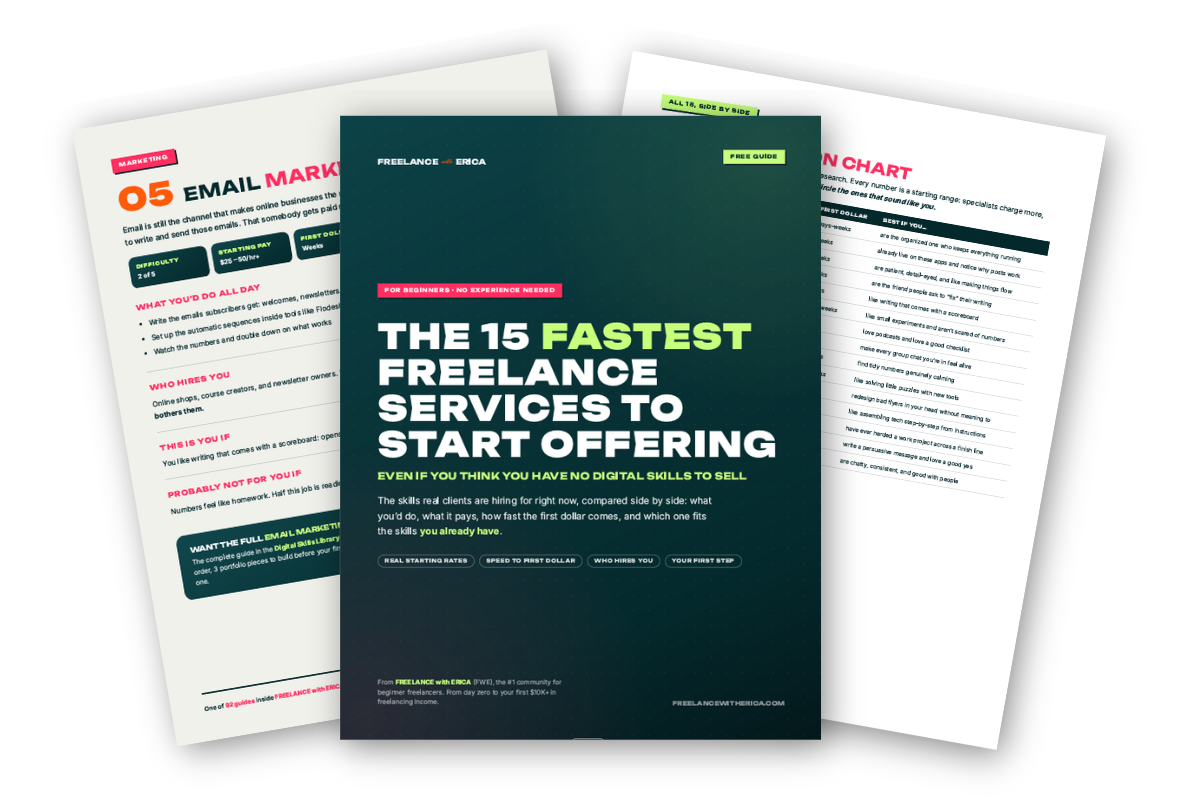
Get The 15 Fastest Freelance Services to Start Offering: all 15 compared side by side, with a clear read on which one fits the skills you already have.
📬 Go check your email!
Your free guide is on its way to your inbox right now. If it plays hide-and-seek, peek in the spam or promotions folder.
Level up later
Skills that stack with bookkeeping
The highest-earning freelancers combine two or three skills, so one small project turns into steady monthly work.
Virtual Assistance
One trusted person handling both the numbers and the admin. A natural move from a single retainer into a broader operational role.
Read the Guide →Financial Planning
Bookkeeping is the foundation; financial planning is the next floor up. Knowing the numbers prepares you to advise on them too.
Read the Guide →Bookkeeper FAQ
How much do freelance bookkeepers make?+
Priced around a specialty and packaging, beginners realistically charge $25–45 an hour or more, or start on monthly retainers of $300–600+. Intermediate bookkeepers with a specialty and reviews charge $45–75/hr or $600–1,500/mo per client, and experienced specialists with a full client roster charge $75–150/hr+ or command retainers of $1,500–3,500+ per client per month. The six-figure path is a portfolio of retainer clients built over time. No rate is guaranteed; these are the ranges people reach as they build proof.
Do I need a degree or CPA license to do bookkeeping?+
No. You don’t need an accounting degree or a CPA license to work as a bookkeeper. The QuickBooks ProAdvisor certification and the Xero Advisor certification are both free, industry-recognized, and exactly what clients look for. Many working freelance bookkeepers have no formal finance education at all, just the certifications, software fluency, and attention to detail.
Is bookkeeping still a good skill in the age of AI?+
Yes, if anything more so. AI automates the tedious parts: bulk transaction categorization, rule matching. But it can’t catch a bank transfer miscategorized as revenue, notice a recurring charge that quietly disappeared, or calmly explain to a nervous owner why their numbers look different this quarter. Clients pay you for that judgment and that trust, every month.
What’s the difference between a bookkeeper and an accountant?+
A bookkeeper maintains the day-to-day financial records: categorizing transactions, reconciling accounts, producing monthly financials. An accountant, especially a CPA, analyzes those records, prepares taxes, and handles compliance. You keep the books clean; their CPA uses them at tax time. Bookkeeping never includes tax filing, and that line matters for setting client expectations.
How do I get my first bookkeeping client?+
The fastest path is Upwork: look for bounded jobs like "QuickBooks Online setup for new LLC," "catch-up bookkeeping for 6 months," or "monthly bookkeeping for small ecommerce store." Deliver impeccably, over-communicate, and earn your first review. From there the path grows off-platform through referrals and your specialty reputation.
Get started, $9/mo
Ready to learn the how?
The full bookkeeping guide is one piece of the starting tier. Everything on the right comes with it.
- The full Digital Skills Library, all 90+ guides
- The Find Your Freelance Ready Skills training
- The FWE community chat forum
- Weekly co-working calls
- Five monthly contests for cash
- The monthly accountability challenge
- The proposal tracker that comes with it
- Live guest trainings