Digital Skills Library · Design & Creative
How to become a freelance illustrator
What freelance illustrators charge in 2026, the services clients hire for, and the beginner's path from no experience to your first paying client.
Difficulty
3 of 5
Learnable from zero, no degree required, but the craft and a recognizable style take real practice time
First dollar
Moderate
Depends heavily on your portfolio; a focused, stylish body of work shortens it dramatically
Startup cost
Low
Procreate on an iPad, or free desktop tools, get you to your first paid piece
AI-friendliness
Medium
Generic illustration is pressured by AI; a distinctive style and brand systems are resilient and command premiums
Demand
Steady & specialized
Always demand for human-made, on-brand, ownable art
Start here
Go from curious to freelance-ready
This page shows you what freelance illustration work is like: the pay, the services, and whether it fits you. The full guide inside the Digital Skills Library walks you through getting started: what to learn first, where to learn it, and how to practice until you're ready to offer it as a freelance service. Here's what unlocks for this skill:
- 🔒 A 4-week illustration learning plan: what to learn, in order
- 🔒 Hand-picked courses and videos, with the why behind every pick
- 🔒 The illustration tools to set up on day one
- 🔒 3 work samples you can build before you have a single client
- 🔒 Ready-to-use AI prompts for moodboards and ideation
- 🔒 Which skill to add next, and why it raises your freelance rate
- 🔒 The big-picture map: first spot illustration, then a set, then a branded system
- 🔒 Updates whenever the tools and the market change
The skill, straight
What does a freelance illustrator do?
Illustration is custom art for hire: spot illustrations, characters, book pages, and icon sets, the stuff that makes a brand, a book, or a story look like nothing else out there. A client falls for a specific look in your portfolio, then hires you to make more of exactly that look. AI can spit out the cheap, generic version for free now, and that's exactly why an illustrator with a real, recognizable style is worth more than ever.
01
Give a brand, book, or story a look nobody else has
A distinctive style that makes something instantly, unmistakably theirs. Recognition is the whole point.
02
Hold one style across a whole set
Clients pay a premium for consistency: a cast of characters, a series, a set that clearly comes from the same hand, project after project.
03
Turn a vague idea into a finished, ownable piece
A publisher or founder has a story or a vibe and no way to draw it. You take the ask and hand back custom art they can use and own.
Is illustration right for you?
Yes
You are visually distinctive, or a style is forming, and you would rather go deep on one look than be a do-everything generalist. You are patient with craft: you will redraw a hand five times to get it right and enjoy it. If you have ever lost three hours to a drawing and looked up surprised, you already have the temperament for this job.
Maybe
You have skill but no style yet. That is fixable, style comes from putting in the reps and leaning into what you naturally do. Give it real months of patient practice. Plan for the runway.
No
You want the fastest possible path to a first dollar and you do not enjoy making art. The craft itself has to pull you, or a faster-to-cash skill will serve you better.
Best for artistic, visually distinctive, patient craft-lovers, people with (or building toward) a recognizable personal style. If you've ever lost three hours to a drawing and looked up surprised, you already have the temperament for this job.
Pick a lane
Illustration services you can sell
You don't sell "illustration." You sell a specific kind of art in a specific style a client already wants. "I make warm, hand-drawn character illustrations for children's brands" wins against "I draw anything."
Your Free Unlock
Get the full member version of this guide, free
Everything on this page is the short version. The member guide goes all the way: the step-by-step learning plan, the tools, the AI prompts, and the practice projects that build real skill. Every person gets one guide free, and it can be this one.
Unlock This Guide Free → One Free Guide Per PersonAlready unlocked a guide, or already a member? Log in here.
How the money grows
The illustration service ladder
Four steps from your first single piece to an ongoing visual partnership. These prices are market averages, and premium freelancers charge well beyond them.
Starter
Single spot illustration
$75–250+
One illustration, a blog or social spot, an icon, a simple character, delivered in your style. Bounded, fast, and the cleanest way to show your look.
Core
Illustration set or series
$500–2.5K+
A cohesive set, a batch of social spots, a sticker pack, or a small character cast, all consistent in style. Proves you can hold a look across pieces.
Premium
Branded illustration system or book project
$3K–15K+
A full custom illustration system for a brand, or a complete book project. The work that defines how something looks to the world.
Retainer
Ongoing illustration partner
$1.5K–6K+ /mo
Monthly illustration on demand in a house style you own, plus licensing your existing art for recurring royalties. Everyone starts hourly; retainers come once your rate and portfolio are built (I teach them in my final course).
Who buys illustration?
Anyone whose business depends on looking credible and cannot, or will not, do it themselves. You've heard every one of these:
People hire an illustrator when they already know they need a look nobody else has and need someone they trust to make it happen. Usually right after a content push, a product launch, or a competitor forces the question.
The numbers
How much do illustrators make?
You've seen the "draw me anything, $5 a piece" gigs floating around every freelance site. Skip those, they'll burn you out fast and pay nothing like what your style is worth. The ranges below are an example of what average freelancers charge on Upwork in 2026, and they're a good reference while you're starting out. Inside FREELANCE with ERICA, you'll learn how to position your services for premium pricing over time.
Beginner
$25–60/hr+
A recognizable style emerging, a focused portfolio, and the discipline to price per piece and to charge for usage, well beyond the drawing itself.
Intermediate
$60–125/hr+
A distinct, consistent style, reviews, and the ability to hold a look across a whole set.
Advanced
$125–200/hr+
A sought-after style, brand-system and book work, value and licensing-based pricing that ignores the clock entirely.
Style, usage rights, and brand value move your rate here, way more than raw hours do. A "give me anything, cheap" illustrator charges by the picture and competes with the whole internet, AI included. "A children's-book illustrator with a warm, gouache-inspired style" charges by the project and the rights, with almost no competition in sight. That's why every number above ends in a plus: keep building your style and your rate climbs with it.
One more thing, and I want you to really hear this: those ranges are averages, and averages have zero say over what you get to charge someday. As you work through my courses, you'll learn how to stack skills and position your services, so you can become a premium freelancer who charges above the market. Here's my own example: I'm a sales copywriter. Look up copywriters on Upwork and you'll see averages between $10 and $75 an hour. I regularly charge over $200 an hour for the same skill, because there are clients who happily pay for real expertise, and you only need a handful of them.
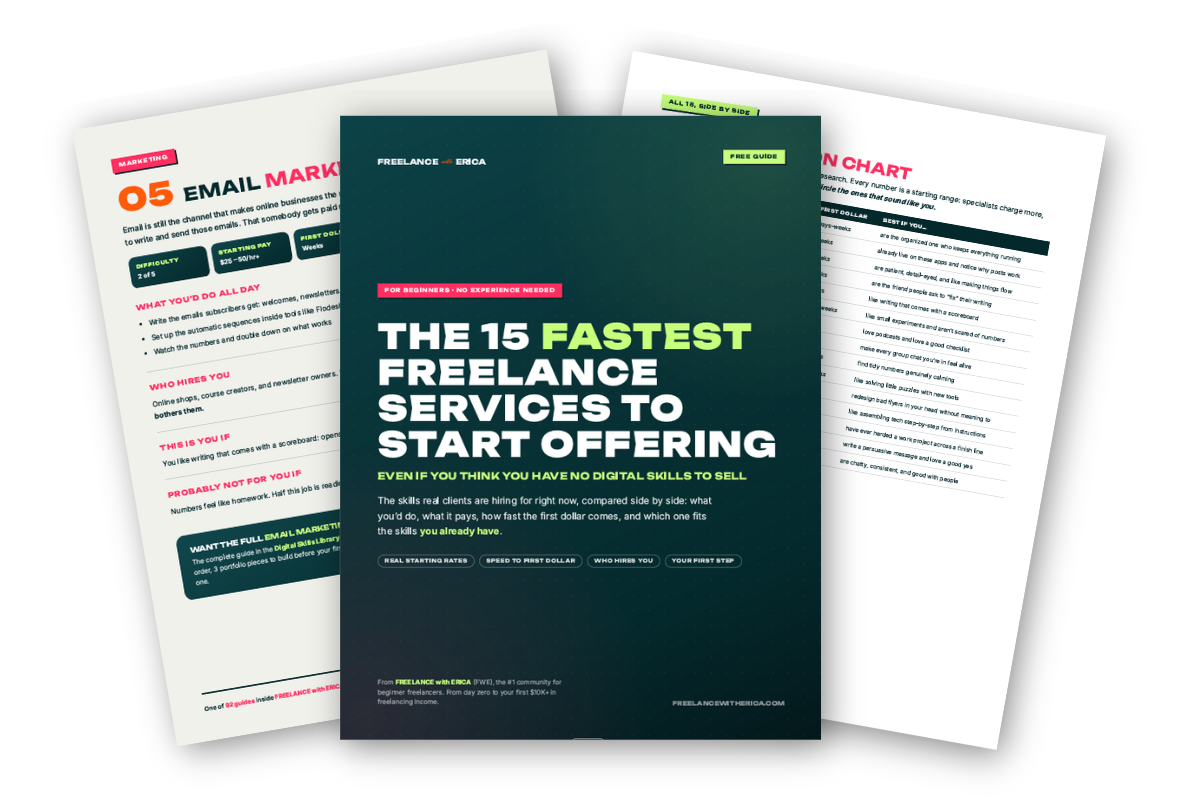
Free guide
Not sure this is your lane?
Get The 15 Fastest Freelance Services to Start Offering: all 15 compared side by side, with a clear read on which one fits the skills you already have.
📬 Go check your email!
Your free guide is on its way to your inbox right now. If it plays hide-and-seek, peek in the spam or promotions folder.
Level up later
Skills that stack with illustration
The highest-earning freelancers combine two or three skills, so one design project turns into steady monthly work.
Graphic Design
Illustration plus layout is the bundle clients dream of: you can create the art AND drop it into a finished social kit or deck. An illustrator who can lay out a piece rarely waits for work.
Read the Guide →Branding & Logo Design
Custom illustration is one of the strongest ways a brand stands out: mascots, illustrated icon systems, hand-drawn brand worlds. Premium, ongoing-shaped work.
Read the Guide →Video Editing
Your characters and illustrations are the raw material for motion. Adding basic animation turns a static piece into an explainer or a social reel.
Read the Guide →Illustration FAQ
How much do freelance illustrators make?+
Priced around style and usage rights, beginners realistically charge $25–60/hr or $75–250+ per spot illustration. Intermediate illustrators with a distinct style charge $60–125/hr+ on sets and character design. Experienced illustrators doing branded systems, book projects, and licensing charge $125–200/hr+, with royalties going higher. The cheap "draw me anything" tier is the race-to-the-bottom you should avoid. These are positioning-based ranges, so use them as a starting point.
Can I become a freelance illustrator with no experience or degree?+
Yep, no degree or license needed. But there is a runway to know about: illustration is portfolio-and-style-driven, so how fast you land a client depends almost entirely on having a focused body of work in a recognizable style. Already draw? You can build that fast. Starting from a blank sketchbook? Budget months of patient practice first.
Is illustration still a good career in the age of AI?+
It depends which tier you are in. AI image generation pressures generic illustration. But a distinctive personal style AI cannot reproduce, branded illustration systems, and book or character work that needs narrative judgment are resilient and command premiums. Lean into a style that is unmistakably yours, that is what keeps you out of the cheap-volume race.
Which illustration niche is best for a beginner?+
Spot and social illustration, or portraits and caricatures, are the fastest to first paid work: small, bounded, and easy to show off a style. Children's-book and character work are higher-value but more competitive. Pick one lane, build 8-12 strong pieces in a consistent look, and lead with that focus.
How do I get my first illustration client?+
The fastest on-ramp is Upwork: look for bounded jobs like "illustrate 5 blog spots in [style]," "design a mascot character," or "create a custom pet portrait." Deliver clean, on-style work as proof, get the review, and turn it into the next gig.
Get started, $9/mo
Ready to learn the how?
The full illustration guide is one piece of the starting tier. Everything on the right comes with it.
- The full Digital Skills Library, all 90+ guides
- The Find Your Freelance Ready Skills training
- The FWE community chat forum
- Weekly co-working calls
- Five monthly contests for cash
- The monthly accountability challenge
- The proposal tracker that comes with it
- Live guest trainings