Digital Skills Library · Design & Creative
How to become a freelance product designer
What freelance product designers (UX/UI) charge in 2026, the services clients hire for, and the beginner's path from no experience to your first paying client.
Difficulty
3 of 5
No degree needed, but UX is a real discipline: research and flows take focused learning
First dollar
Medium
Budget a few months to build real skill and a portfolio, then demand is strong
Startup cost
Low
Figma, the industry tool, has a free tier that takes you all the way to paid
AI-friendliness
High
AI assists with mockups and ideas; user research and product thinking stay human
Demand
High & durable
Every app and digital product needs design, and good UX is always scarce
Start here
Go from curious to freelance-ready
This page shows you what freelance product design work is like: the pay, the services, and whether it fits you. The full guide inside the Digital Skills Library walks you through getting started: what to learn first, where to learn it, and how to practice until you're ready to offer it as a freelance service. Here's what unlocks for this skill:
- 🔒 A 4-week product design learning plan: what to learn, in order
- 🔒 Hand-picked courses and videos, with the why behind every pick
- 🔒 The Figma and UX tools to set up on day one
- 🔒 2-3 case studies you can build before you have a single client
- 🔒 Ready-to-use AI prompts for research synthesis and design rationale
- 🔒 Which skill to add next, and why it raises your freelance rate
- 🔒 The big-picture map: first single screens, then whole features, then full products
- 🔒 Updates whenever the tools and the market change
The skill, straight
What does a freelance product designer do?
Product design (often called UX/UI design) is designing digital products, apps, and websites so they are both easy to use and good to look at: UX (the research and logic that makes a product make sense) plus UI (the actual screens, clean and on-brand). AI can now generate a rough mockup in seconds, and that's exactly what makes a human who understands real users and makes smart product decisions worth even more.
01
Turn a rough idea into screens people can use
A vague "we need an app" becomes flows and screens a developer can build and a user will understand. Clarity is the whole job.
02
Catch the wrong decision before it gets built
Research and testing surface the confusing parts before code gets written. That's what saves a client real money.
03
Build a system a whole team can reuse
A design system turns one screen into a consistent language the entire product speaks. That kind of work pays well and sticks around.
Is product design right for you?
Yes
You care about how things work, you notice good and bad design everywhere, and you like solving problems for real people. If a confusing app makes you rant about exactly how you would fix it, that instinct is the job.
Maybe
You only want to make things look pretty. The screens matter, but the thinking behind them is what makes you valuable, and that is learnable. It takes more patience than pure visual design.
No
You have no patience for research, iteration, or user feedback. This work is iterative by nature, and that cannot be skipped.
Best for empathetic problem-solvers who care about how things work, well beyond how they look. If a confusing app makes you rant about exactly how you'd fix it, that instinct is the job.
Pick a lane
Product design services you can sell
Get specific about the exact problem you fix. Clients already know what's broken, so name it: "I design onboarding flows for SaaS apps" beats "I can design any kind of screen," every time.
Your Free Unlock
Get the full member version of this guide, free
Everything on this page is the short version. The member guide goes all the way: the step-by-step learning plan, the tools, the AI prompts, and the practice projects that build real skill. Every person gets one guide free, and it can be this one.
Unlock This Guide Free → One Free Guide Per PersonAlready unlocked a guide, or already a member? Log in here.
How the money grows
The product design service ladder
Four steps from your first screen to an ongoing product design partnership. These prices are market averages, and premium freelancers charge well beyond them.
Starter
Screen or flow design
$25–50/hr+
A set of UI screens, a single flow, or a redesign of one feature. A bounded first project.
Core
Feature / app section design
$2K–8K+
End-to-end design of an app section or feature: research, wireframes, UI, and a clickable prototype.
Premium
Full product design
$8K–30K+
Designing a whole product or MVP: UX research, a design system, and developer handoff.
Retainer
Product design partner
$3K–10K+ /mo
Ongoing design for a startup or product team: new features, iteration, and design-system upkeep. Everyone starts hourly; retainers come once your rate and portfolio are built (I teach them in my final course).
Who buys product design?
Anyone building a digital product with no one on the team to design it well. You've heard every one of these:
People hire a product designer when an app or product already exists (or is about to), and they need someone who can make it make sense. Usually right after a confusing launch, a funding round, or a feature nobody uses forces the question.
The numbers
How much do product designers make?
Somewhere on Upwork right now, a job post is asking for a full app redesign for whatever's left in someone's PayPal. 🙃 Ignore it. The ranges below are an example of what average freelancers charge on Upwork in 2026, and they're a good reference while you're starting out. Inside FREELANCE with ERICA, you'll learn how to position your services for premium pricing over time.
Beginner
$25–50/hr+
Figma skills, UX fundamentals, and a portfolio of real or realistic project work.
Intermediate
$50–90/hr+
Reviews, a niche, and end-to-end projects with prototypes that prove your thinking.
Advanced
$90–150/hr+
Full product design, design systems, and ongoing startup partnerships, where the thinking is the product.
Here's the real lever: charge for the problem you solve. A "UI designer" charges per screen and competes with everyone on Upwork. "I design onboarding flows for early-stage SaaS startups" competes with almost no one, and charges accordingly. Every number above ends in a plus for a reason: keep leveling up and your rate keeps climbing with you.
One more thing, and I want you to really hear this: those ranges are averages, and averages have zero say over what you get to charge someday. As you work through my courses, you'll learn how to stack skills and position your services, so you can become a premium freelancer who charges above the market. Here's my own example: I'm a sales copywriter. Look up copywriters on Upwork and you'll see averages between $10 and $75 an hour. I regularly charge over $200 an hour for the same skill, because there are clients who happily pay for real expertise, and you only need a handful of them.
Free guide
Not sure this is your lane?
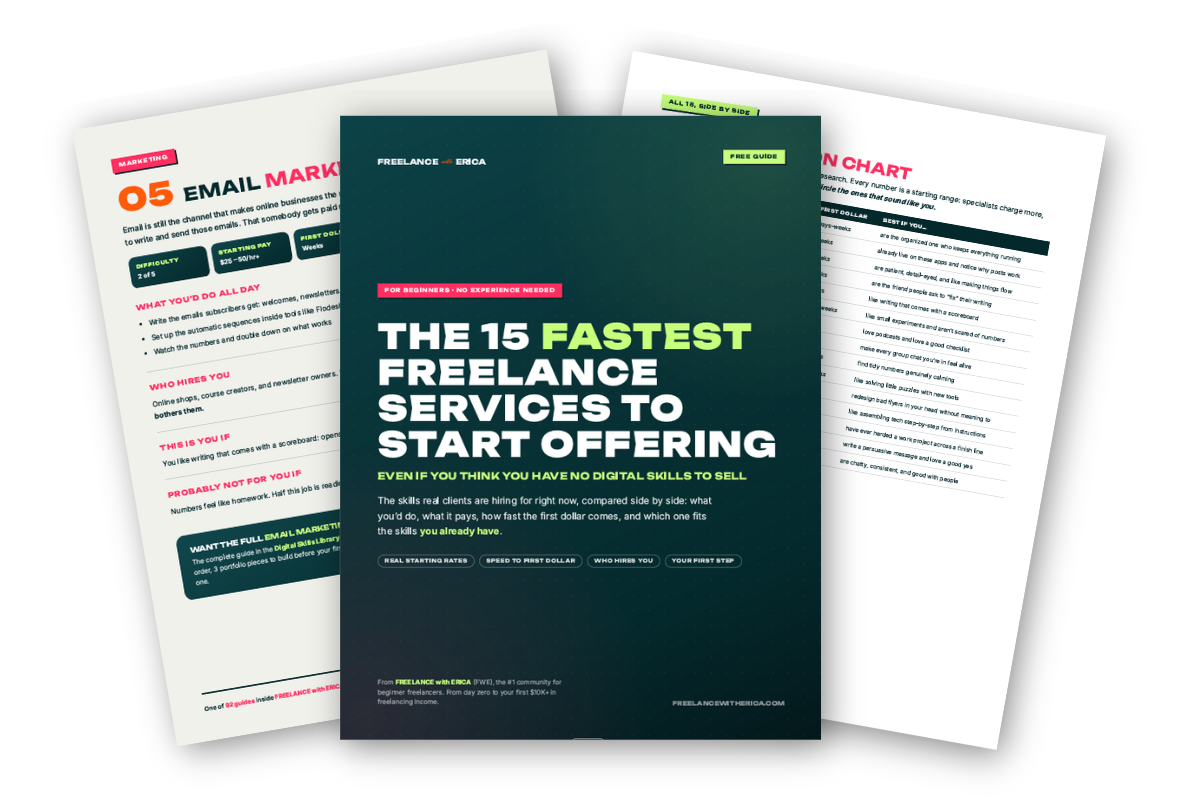
Get The 15 Fastest Freelance Services to Start Offering: all 15 compared side by side, with a clear read on which one fits the skills you already have.
📬 Go check your email!
Your free guide is on its way to your inbox right now. If it plays hide-and-seek, peek in the spam or promotions folder.
Level up later
Skills that stack with product design
The highest-earning freelancers combine two or three skills, so one editing batch turns into steady monthly work.
Web & Mobile Design
Web and mobile UI design is the visual layer of product design. The skills and clients overlap heavily.
Read the Guide →Graphic Design
Visual design fundamentals like type, color, and layout make your product UI polished and professional.
Read the Guide →Generative AI
AI tools speed up mockups, assets, and ideation. Pairing them with UX thinking keeps you ahead.
Read the Guide →Product design FAQ
How much do freelance product designers make?+
Beginners charge $25–50/hr, intermediate designers $50–90/hr, and experienced ones $90–150/hr with full product work and ongoing startup partnerships. Where you land inside those ranges comes down to your positioning and your portfolio.
Can I become a product designer with no experience or degree?+
Yes. No degree is required; a portfolio and real skill are what matter. Free resources teach UX, Figma has a free tier, and a couple of strong case studies get you hired.
Is product design safe from AI?+
Yes, in the way that matters. AI generates mockups and speeds up production, but understanding real users and designing flows that work stay human. Use AI to move faster and sell the thinking.
What is the difference between this and web/mobile design?+
Web & Mobile Design (its own guide) focuses on the UI, visual layer. Product design is the broader role: UX research and thinking plus the UI. Many designers do both; product design pays more.
How do I get my first client?+
Upwork has steady "UX," "UI," "app design," and "Figma" jobs. Build two or three case studies, start with a single flow, and grow into full product work.
Get started, $9/mo
Ready to learn the how?
The full product design guide is one piece of the starting tier. Everything on the right comes with it.
- The full Digital Skills Library, all 90+ guides
- The Find Your Freelance Ready Skills training
- The FWE community chat forum
- Weekly co-working calls
- Five monthly contests for cash
- The monthly accountability challenge
- The proposal tracker that comes with it
- Live guest trainings