Digital Skills Library · Development & IT
How to become a freelance QA tester
What freelance QA testers charge in 2026, no coding required to start, and the beginner's path from no experience to your first paying client.
Difficulty
2 of 5
Manual QA is one of the most accessible tech entries; automation QA adds coding later
First dollar
Fast
Manual testing needs no coding, so you can start earning relatively quickly
Startup cost
None
The tools and learning are free
AI-friendliness
Medium
AI generates tests, so sell exploratory testing and real bug-hunting
Demand
Steady
All software needs testing, and QA is a common door into a tech career
Start here
Go from curious to freelance-ready
This page shows you what freelance QA and software testing work is like: the pay, the services, and whether it fits you. The full guide inside the Digital Skills Library walks you through getting started: what to learn first, where to learn it, and how to practice until you're ready to offer it as a freelance service. Here's what unlocks for this skill:
- 🔒 A step-by-step QA learning plan: what to learn first, no coding required
- 🔒 Hand-picked free courses and communities, with the why behind every pick
- 🔒 The bug-report format that gets you rehired, chapter and verse
- 🔒 A test plan and bug-report sample you can put in a portfolio before you have a client
- 🔒 Ready-to-use AI prompts for test cases, bug reports, and client updates
- 🔒 Which skill to add next (automation, coding) and why it roughly doubles your rate
- 🔒 The big-picture map: first manual testing, then structured QA, then automation
- 🔒 Updates whenever the tools and the market change
The skill, straight
What does a QA tester do?
QA (quality assurance) and software testing means making sure software works before real users hit it: finding bugs, testing features, and reporting issues clearly so developers can fix them. Manual QA, testing software by using it methodically, needs no coding to start, which makes it one of the most accessible ways into tech there is.
01
Break software before users do
Methodically testing an app or site and reporting exactly what's broken. No coding needed, which makes this one of the most accessible doors into tech there is.
02
Write bug reports developers can act on
Clear, reproducible reports that tell a developer exactly what happened and how to see it themselves. The real output, and what gets you rehired.
03
Climb into automation
Writing code that tests software automatically, at scale, on every release. That's the leap that roughly doubles your rate.
Is QA testing right for you?
Yes
You're meticulous, you notice when things are slightly off, and finding a problem satisfies you. If you instinctively try to break things and notice every glitch, that instinct is the job.
Maybe
You're not naturally detail-oriented. The whole job is catching what everyone else missed, so this one takes real practice.
No
Repetitive, methodical checking bores you, or documentation has zero appeal. Bug reports are the real output here; that's a real, constant part of the job.
Best for detail-obsessed, methodical people who love finding what's broken, no coding needed to start. If you instinctively try to break things and notice every glitch, that instinct is the job.
Pick a lane
QA services you can sell
You don't sell "QA." You sell specific, named services a client already knows they need. "I test every release before it ships and report bugs your devs can act on" wins against "I test software."
Your Free Unlock
Get the full member version of this guide, free
Everything on this page is the short version. The member guide goes all the way: the step-by-step learning plan, the tools, the AI prompts, and the practice projects that build real skill. Every person gets one guide free, and it can be this one.
Unlock This Guide Free → One Free Guide Per PersonAlready unlocked a guide, or already a member? Log in here.
How the money grows
The QA service ladder
Four steps from your first manual test to a recurring monthly QA partnership. These prices are market averages, and premium freelancers charge well beyond them.
Starter
Manual testing
$15–25/hr+
Test an app or site, find and clearly report bugs. No coding needed. A great first tech job.
Core
Structured QA
$25–45/hr+
Writing test cases, running test plans, regression testing, and clear bug reports for a product team.
Premium
Automation QA
$45–80/hr+
Writing automated tests (Selenium, Cypress, Playwright), CI integration, and test frameworks.
Retainer
QA partner
$2K–8K+/mo
Ongoing testing for a product team: every release tested, test suites maintained, monthly. Everyone starts hourly; retainers come once your rate and portfolio are built (I teach them in my final course).
Who hires QA testers?
Anyone shipping software who can't afford to let real users find the bugs first. You've heard every one of these:
People hire a freelance QA tester the moment a launch is coming up, a release schedule gets scary, or a founder finally admits nobody's testing the product before it ships. The trigger is constant, which is exactly why the QA partnership sells itself.
The numbers
How much do QA testers make?
There are job posts out there offering pennies for careful, detail-obsessed bug hunting. Skip them. The ranges below are an example of what average freelancers charge on Upwork in 2026, and they're a good reference while you're starting out. Inside FREELANCE with ERICA, you'll learn how to position your services for premium pricing over time.
Beginner
$15–25/hr+
Methodical manual testing, plus clear, useful bug reports.
Intermediate
$25–45/hr+
Test plans, structured QA, reviews, and proven reliability.
Advanced
$45–80/hr+
Automation testing (real code), frameworks, and QA-process leadership.
Premium
$100–200/hr+
Senior QA architects and automation leads who build the test infrastructure a whole team relies on. Specialized QA leadership pays premium rates.
Automation is where the real money jump lives. A beginner who only knows manual testing competes with every other manual tester on Upwork. Someone who can write automated tests and integrate them into a release pipeline charges roughly double, and competes with far fewer people.
One more thing, and I want you to really hear this: those ranges are averages, and averages have zero say over what you get to charge someday. As you work through my courses, you'll learn how to stack skills and position your services, so you can become a premium freelancer who charges above the market. Here's my own example: I'm a sales copywriter. Look up copywriters on Upwork and you'll see averages between $10 and $75 an hour. I regularly charge over $200 an hour for the same skill, because there are clients who happily pay for real expertise, and you only need a handful of them.
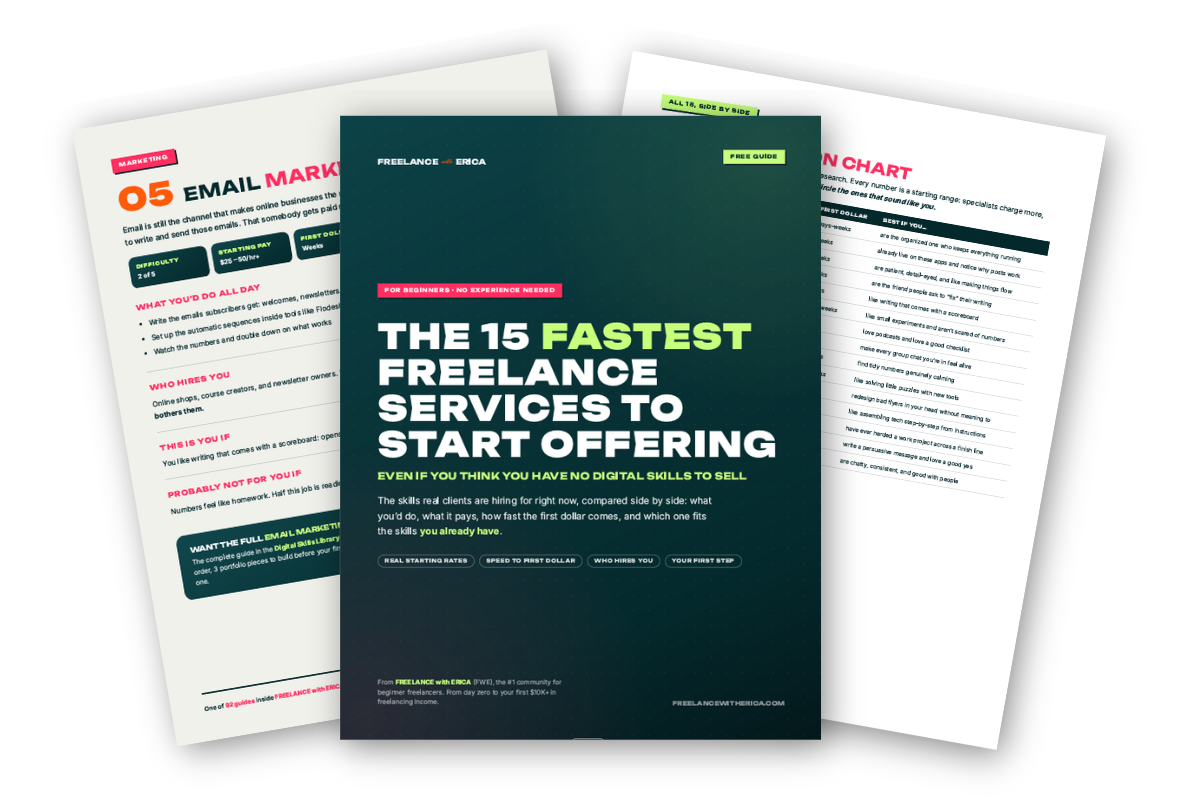
Free guide
Not sure this is your lane?
Get The 15 Fastest Freelance Services to Start Offering: all 15 compared side by side, with a clear read on which one fits the skills you already have.
📬 Go check your email!
Your free guide is on its way to your inbox right now. If it plays hide-and-seek, peek in the spam or promotions folder.
Level up later
Skills that stack with QA
The highest-earning freelancers combine two or three skills, so one small project turns into steady monthly work.
Web Development
Understanding how apps are built makes you a sharper tester. It also opens the door to automation work.
Read the Guide →Project Management
QA and process roles overlap constantly on real teams. Understanding both makes you more valuable, and more promotable.
Read the Guide →AI & Automation Workflows
Automated test suites run on the same logic as automated pipelines. A natural stack once you start writing automation.
Read the Guide →QA testing FAQ
Can I do QA with no coding or experience?+
Yes, manual QA is one of the most accessible tech entries and needs no coding. You test software methodically and report bugs clearly. Add coding later for automation QA and higher pay.
How much do freelance QA testers make?+
Manual QA runs $15-25/hr, QA engineers $25-45/hr, and automation QA $45-80/hr+. The jump comes from learning automation. These ranges are a starting reference, and premium positioning gets you well past them.
Is QA a good way into tech?+
Yes, it's a classic on-ramp. Start in manual QA without coding, learn how software works, then grow into automation, development, or product roles.
Is QA safe from AI?+
The basic, repetitive tier is pressured by AI-generated tests, so don't stay there. Exploratory testing (finding weird real bugs), judgment, and automation engineering stay valuable.
How do I get my first client?+
Upwork has "manual testing," "QA," "bug testing," and "app testing" jobs. Practice testing apps and writing clear bug reports, start with manual work, and learn automation to climb.
Get started, $9/mo
Ready to learn the how?
The full QA testing guide is one piece of the starting tier. Everything on the right comes with it.
- The full Digital Skills Library, all 90+ guides
- The Find Your Freelance Ready Skills training
- The FWE community chat forum
- Weekly co-working calls
- Five monthly contests for cash
- The monthly accountability challenge
- The proposal tracker that comes with it
- Live guest trainings