Digital Skills Library · Development & IT
How to become a freelance software developer
What freelance software developers charge in 2026, the real months-long learning runway, and the path from your first script or tool to complex, specialized systems.
Difficulty
4 of 5
Real programming and computer-science fundamentals; a serious, months-long runway
First dollar
Slow
A big learning investment, but high-paid and durable once you arrive
Startup cost
None
All the tools and learning are free
AI-friendliness
Medium-high
AI writes lots of code, so sell engineering judgment, architecture, and ownership
Demand
High
Software runs everything, and skilled developers stay in demand
Start here
Go from curious to freelance-ready
This page shows you what freelance software development work is like: the pay, the services, and whether it fits you. The full guide inside the Digital Skills Library walks you through getting started: what to learn first, where to learn it, and how to practice until you're ready to offer it as a freelance service. Here's what unlocks for this skill:
- 🔒 A real, structured learning path: programming fundamentals first, then CS basics, then a specialty
- 🔒 Hand-picked free resources (CS50, freeCodeCamp, The Odin Project), with the why behind every pick
- 🔒 The portfolio projects that prove you can solve a real problem, well beyond a single tutorial exercise
- 🔒 Integration practice connecting two real services with code, a common, sellable first task
- 🔒 Ready-to-use AI prompts for architecture decisions, debugging, and code review
- 🔒 Which specialty to add, and why it raises your freelance rate
- 🔒 The big-picture map: first scripts and tools, then applications, then complex specialized systems
- 🔒 Updates whenever the tools and the market change
The skill, straight
What does a software developer do?
Software development covers way more than websites or apps. It's the programs, scripts, tools, and integrations businesses run on behind the scenes: custom applications, automation, APIs, and data tools.
01
Build the programs businesses quietly run on
Scripts, tools, and integrations that solve one clear problem. Work that often runs invisibly in the background, well beyond a website or an app.
02
Connect systems and automate the tedious
Wiring services together with code, and turning hours of manual work into something that runs itself.
03
Grow into complex, specialized systems
Architecture and engineering decisions for software that needs real depth. This is where the pay tops the entire dev range.
Is software development right for you?
Yes
You love solving problems with logic, you're persistent through frustration, and you want to invest in a high-paid technical skill. People who enjoy how systems work thrive here.
Maybe
You want fast income. The runway is real; pair it with a faster Library skill while you learn.
No
You don't enjoy programming or can't commit to a long learning curve. A lighter dev lane or a faster skill may suit you better.
Best for logical problem-solvers who enjoy programming. If you like puzzles and building things that solve real problems, you're already halfway there.
Pick a lane
Software services you can sell
Skip the "I know Python" pitch. Sell the specific problem a client already knows they have. "I'll connect these two systems so the data flows automatically" beats "I'm a software developer" every time.
Your Free Unlock
Get the full member version of this guide, free
Everything on this page is the short version. The member guide goes all the way: the step-by-step learning plan, the tools, the AI prompts, and the practice projects that build real skill. Every person gets one guide free, and it can be this one.
Unlock This Guide Free → One Free Guide Per PersonAlready unlocked a guide, or already a member? Log in here.
How the money grows
The software service ladder
Four steps from your first script or tool to a recurring monthly engineering partnership. These prices are market averages, and premium freelancers charge well beyond them.
Starter
Script or small tool
$20–40/hr+
A script, automation, small tool, or bug fix that solves one clear problem. A bounded first job.
Core
Application / integration
$40–80/hr+
Building an app, an API integration, or a custom tool that a business runs on.
Premium
Complex / specialized systems
$80–150/hr+
Complex software, data systems, or specialized engineering with real architecture decisions.
Retainer
Engineering partner
$4K–15K+/mo
Ongoing development for a company's software: features, maintenance, and improvements, monthly. Everyone starts hourly; retainers come once your rate and portfolio are built (I teach them in my final course).
Who hires software developers?
Anyone with a problem code could solve. You've heard every one of these:
People hire a freelance software developer the moment a manual process eats real hours, two systems need to talk to each other, or off-the-shelf software just doesn't cut it. That happens all the time, which is why the work stays steady.
The numbers
How much do software developers make?
Real talk: there are software gigs on Upwork asking a developer to build a whole app for pocket change, and you should scroll right past them. The ranges below are an example of what average freelancers charge on Upwork in 2026, and they're a good reference while you're starting out. Inside FREELANCE with ERICA, you'll learn how to position your services for premium pricing over time.
Beginner
$20–40/hr+
Real programming skill, a language, and a few project samples.
Intermediate
$40–80/hr+
A specialty or stack, reviews, and applications or integrations delivered.
Advanced
$80–150/hr+
Complex systems, architecture skill, and engineering partnerships.
Premium
$150–250/hr+
Architects and specialized engineers whose systems make their clients real money. Deep technical expertise pays premium rates.
Engineering depth and specialization are what push your rate up. A beginner who only knows basic scripting competes with everyone else. Someone who can architect a complex, specialized system competes with far fewer people.
One more thing, and I want you to really hear this: those ranges are averages, and averages have zero say over what you get to charge someday. As you work through my courses, you'll learn how to stack skills and position your services, so you can become a premium freelancer who charges above the market. Here's my own example: I'm a sales copywriter. Look up copywriters on Upwork and you'll see averages between $10 and $75 an hour. I regularly charge over $200 an hour for the same skill, because there are clients who happily pay for real expertise, and you only need a handful of them.
Free guide
Not sure this is your lane?
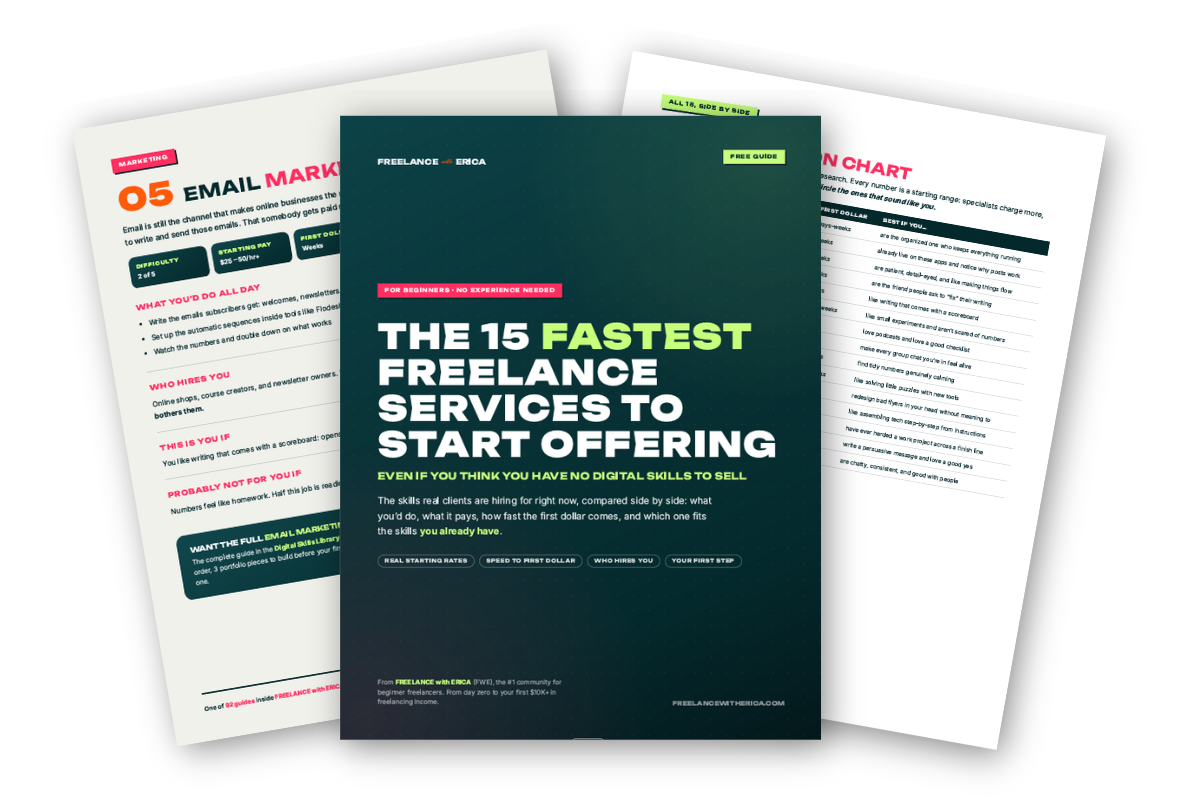
Get The 15 Fastest Freelance Services to Start Offering: all 15 compared side by side, with a clear read on which one fits the skills you already have.
📬 Go check your email!
Your free guide is on its way to your inbox right now. If it plays hide-and-seek, peek in the spam or promotions folder.
Level up later
Skills that stack with software dev
The highest-earning freelancers combine two or three skills, so one project turns into steady monthly work.
Full-Stack Development
Full-stack and general software development overlap heavily. The skills and clients reinforce each other.
Read the Guide →Web Development
Web dev is the most common entry into software work. Programming fundamentals transfer directly.
Read the Guide →AI Automation & Workflows
Coding plus automation lets you build custom integrations and AI-powered tools. High-value, modern work.
Read the Guide →Software development FAQ
How long does it take to become a paid software developer?+
It takes many months of consistent study. You're learning real programming, the same fundamentals a computer science degree covers. Free curricula like CS50, freeCodeCamp, and The Odin Project cover the whole path. Pair it with a faster Library skill if you need income sooner.
How much do freelance software developers make?+
Beginners land $20-40/hr, intermediate devs move to $40-80/hr, advanced developers hit $80-150/hr+, and specialized engineers can charge $150-250/hr and beyond. These are reference ranges to help you gauge the market, and your actual rate depends on your positioning.
Do I need a CS degree?+
Nope. A portfolio of real projects and demonstrated skill matter way more than a degree. Free resources can teach you everything you need.
Is software development safe from AI?+
The job is different now, but it's still very much here. AI can write code fast, but it can't architect a system, make real engineering decisions, debug something complex, or own the outcome. Learn the fundamentals deeply and treat AI as one more powerful tool in your kit.
What language should I learn first?+
Python is beginner-friendly and versatile (automation, data, web, AI); JavaScript is great for web. Pick one, go deep, and build real projects.
Get started, $9/mo
Ready to learn the how?
The complete software development guide is one piece of the starting tier. Everything on the right comes with it.
- The full Digital Skills Library, all 90+ guides
- The Find Your Freelance Ready Skills training
- The FWE community chat forum
- Weekly co-working calls
- Five monthly contests for cash
- The monthly accountability challenge
- The proposal tracker that comes with it
- Live guest trainings