Digital Skills Library · Development & IT
How to become a freelance system administrator
What freelance system administrators charge in 2026, what it takes to learn the skill, and the path from a first server setup to trusted, ongoing infrastructure work.
Difficulty
4 of 5
A technical field; learn the fundamentals (especially Linux) properly to start
First dollar
Slower
This rewards genuine technical learning and proof you can be trusted with systems
Startup cost
Low
Free tools and learning; cloud practice is largely free-tier
AI-friendliness
High
AI assists with scripts and troubleshooting, but responsibility for live systems is human
Demand
Steady
Every business runs on systems that need setup, maintenance, and someone to fix them
Start here
Go from curious to freelance-ready
This page shows you what freelance system administration work is like: the pay, the services, and whether it fits you. The full guide inside the Digital Skills Library walks you through getting started: what to learn first, where to learn it, and how to practice until you're ready to offer it as a freelance service. Here's what unlocks for this skill:
- 🔒 A real, structured learning path: Linux first, then networking, then servers, then the cloud
- 🔒 Hand-picked free resources (Linux Journey, AWS/Azure free training, Professor Messer), with the why behind every pick
- 🔒 The portfolio projects that prove you can run a real system on your own, no tutorial hand-holding
- 🔒 Home lab practice in a safe virtual environment, so mistakes cost nothing before a client's systems are on the line
- 🔒 Ready-to-use AI prompts for explaining commands, writing scripts, and troubleshooting
- 🔒 Which specialty to add, and why it raises your freelance rate
- 🔒 The big-picture map: first server setup, then full administration, then cloud infrastructure
- 🔒 Updates whenever the tools, the cloud, and the market change
The skill, straight
What does system administration involve?
System administration is keeping the servers, networks, and systems a business runs on working, secure, and fast: setup and configuration, maintenance and backups, migrations, and at the high end, cloud infrastructure and scaling.
01
Set up the servers a business quietly runs on
Server and system setup that turns "we need this hosted and configured" into a working, reliable system.
02
Keep systems running and quietly prevent disasters
Maintenance, backups, security, and monitoring, so nothing gets the chance to break in the first place.
03
Become the business's trusted infrastructure partner
Ongoing management and cloud infrastructure as the stakes grow. This is where the pay tops the whole ladder.
Is system administration right for you?
Yes
You're methodical and calm, you like things running smoothly, and you enjoy figuring out why something broke and fixing it. That reliability streak is exactly what this work pays for.
Maybe
You're starting from zero technically. You'll need to learn fundamentals (especially Linux) properly. It's doable with commitment.
No
You want a fast, non-technical first dollar. Start with a content lane, and come to sysadmin when you want a stable technical skill.
Best for methodical, calm people who like things running smoothly and enjoy figuring out why something broke. If reliability feels natural to you, this pays well for exactly that trait.
Pick a lane
Sysadmin services you can sell
Nobody hires "I know servers." They hire a specific outcome they already know they need. "I'll get your server set up and running reliably" wins against "I do IT stuff."
Your Free Unlock
Get the full member version of this guide, free
Everything on this page is the short version. The member guide goes all the way: the step-by-step learning plan, the tools, the AI prompts, and the practice projects that build real skill. Every person gets one guide free, and it can be this one.
Unlock This Guide Free → One Free Guide Per PersonAlready unlocked a guide, or already a member? Log in here.
How the money grows
The sysadmin service ladder
Four steps from your first server setup to a recurring managed-systems partnership. These prices are market averages, and premium freelancers charge well beyond them.
Starter
Server & system setup
$30–45/hr+
Setting up servers, hosting, and basic system configuration for small businesses or developers.
Core
System administration & maintenance
$45–70/hr+
Managing servers, networks, security, backups, and keeping a business's systems healthy.
Premium
Cloud & infrastructure
$70–90/hr+
Cloud infrastructure (AWS, Azure), complex networks, and scaling systems for serious needs.
Retainer
Managed systems / ongoing IT
$1.5K–6K+/mo
Being a business's ongoing systems and infrastructure partner: monitoring, maintenance, support. Everyone starts hourly; retainers come once your rate and portfolio are built (I teach them in my final course).
Who hires system administrators?
Anyone whose systems just became their problem. You've heard every one of these:
People hire a freelance system administrator the moment a server needs setting up, a system breaks at the worst time, or growth outpaces what the business can manage itself. Something is always breaking somewhere, so this work never dries up.
The numbers
How much do system administrators make?
You've probably already seen the job post: "need someone to just keep our server running, budget's tight!!" Skip that one. The ranges below are an example of what average freelancers charge on Upwork in 2026, and they're a good reference while you're starting out. Inside FREELANCE with ERICA, you'll learn how to position your services for premium pricing over time.
Beginner
$30–45/hr+
Fundamentals (especially Linux), server setup, and basic maintenance.
Intermediate
$45–70/hr+
Full system administration, networks, security, and proven reliability.
Advanced
$70–90/hr+
Cloud infrastructure, complex systems, scaling, and specialization.
Premium
$100–150/hr+
Experts trusted to own a business's critical infrastructure end to end, no hand-holding needed. That level of trust pays premium rates.
What moves you up is genuine expertise and proven reliability. A beginner who only offers basic server setup competes with everyone else. Someone who can run cloud infrastructure or manage a complex migration competes with far fewer people.
One more thing, and I want you to really hear this: those ranges are averages, and averages have zero say over what you get to charge someday. As you work through my courses, you'll learn how to stack skills and position your services, so you can become a premium freelancer who charges above the market. Here's my own example: I'm a sales copywriter. Look up copywriters on Upwork and you'll see averages between $10 and $75 an hour. I regularly charge over $200 an hour for the same skill, because there are clients who happily pay for real expertise, and you only need a handful of them.
Free guide
Not sure this is your lane?
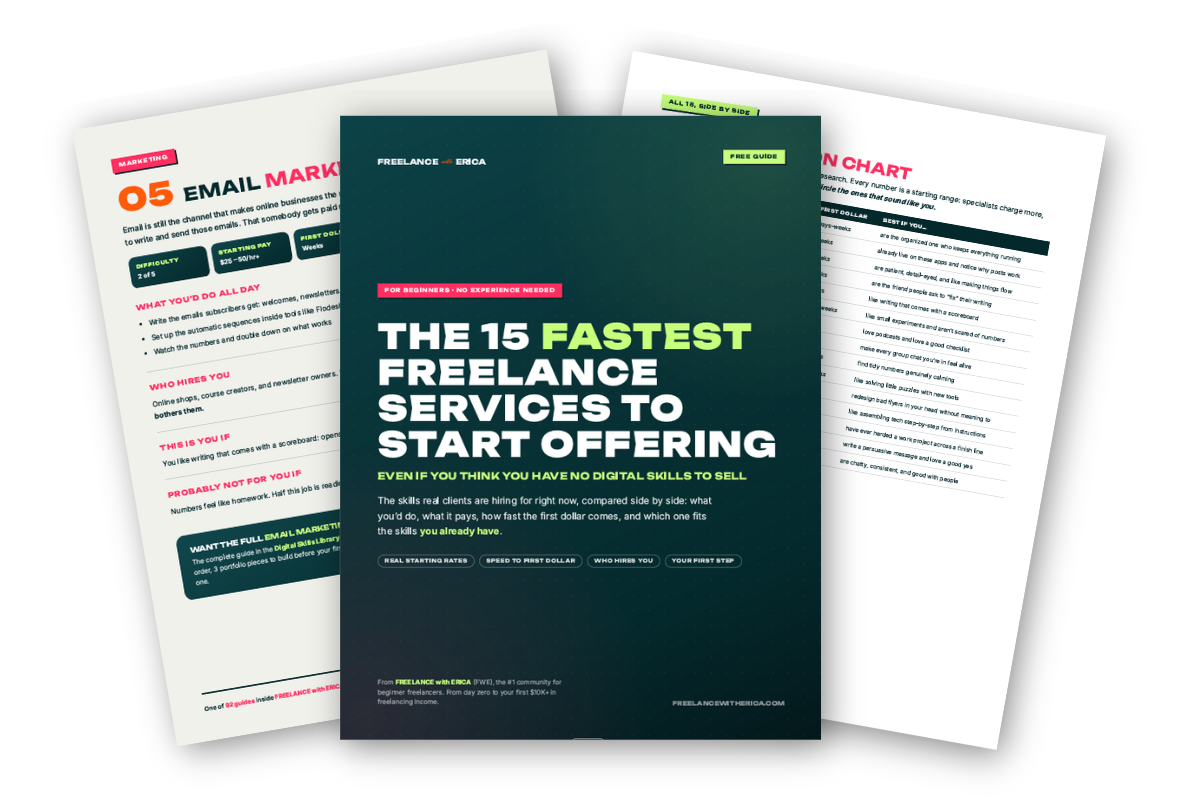
Get The 15 Fastest Freelance Services to Start Offering: all 15 compared side by side, with a clear read on which one fits the skills you already have.
📬 Go check your email!
Your free guide is on its way to your inbox right now. If it plays hide-and-seek, peek in the spam or promotions folder.
Level up later
Skills that stack with sysadmin
The highest-earning freelancers combine two or three skills, so one project turns into steady monthly work.
Security & Compliance
Securing systems is core sysadmin work. Adding security expertise raises your rates directly.
Read the Guide →Database Management
Servers run databases. Knowing both makes you a more complete, more valuable infrastructure pro.
Read the Guide →AI Automation & Workflows
Scripting routine sysadmin tasks is a real force multiplier. The skills reinforce each other directly.
Read the Guide →System administration FAQ
Can I start sysadmin with no experience?+
You can start learning with no experience, but be honest with yourself: this is a real technical field. You'll need to learn fundamentals (especially Linux) properly and build trust before clients hand you their systems.
How much do sysadmins make?+
Setup and basics run $30-45/hr, full administration $45-70/hr, and cloud/infrastructure $70-90/hr+. Managed-systems work adds steady income on top. Treat these as a starting point for where to position yourself; what you charge is up to you.
Do I need to learn Linux?+
Yes, largely. Most servers run Linux, so it's the core skill. The good news: Linux is free to learn and practice, with excellent free resources.
Is this safe from AI?+
Yes. AI assists with scripts and troubleshooting, but the responsibility for keeping live systems running, making infrastructure decisions, and fixing real outages stays human.
How do I get my first client?+
Learn the fundamentals first. Upwork has "system administrator," "server setup," "Linux," and "AWS/cloud" jobs. Start with setup and maintenance and grow into cloud.
Get started, $9/mo
Ready to learn the how?
The complete system administration guide is one piece of the starting tier. Everything on the right comes with it.
- The full Digital Skills Library, all 90+ guides
- The Find Your Freelance Ready Skills training
- The FWE community chat forum
- Weekly co-working calls
- Five monthly contests for cash
- The monthly accountability challenge
- The proposal tracker that comes with it
- Live guest trainings