Digital Skills Library · Engineering & Architecture
Can you freelance in electrical & electronic engineering?
I'll show you real 2026 rates ($50–200/hr for specialized work) and which lanes are skill-gated versus license-gated, so you know exactly where you stand.
Difficulty
5 of 5
Deep technical skill or a degree required, one of the harder lanes in the Library
First dollar
Slow
Real electronics competence takes a long time to build, whether by degree or self-taught
Startup cost
Medium
Design software is free; prototyping hardware and fab runs add up
AI-friendliness
High as a tool
AI speeds firmware and docs, but it can't validate a real circuit
Demand
Real for specialists
Thin and competitive for generalists; the money is in demonstrable skill
Start here
Get the full scoop
This page shows you what freelance electrical and electronics engineering work is like: the pay, the services, and whether it fits you. The full guide inside the Digital Skills Library maps the whole spectrum: what's license-gated like structural engineering, and what's skill-gated and open to a serious builder, so you know exactly where your real lane is. Here's what unlocks for this guide:
- 🔒 The real map up front: which lanes are license-gated like structural engineering, and which are skill-gated and open
- 🔒 A real learning path for the accessible side: fundamentals, KiCad, real projects, firmware, specialization
- 🔒 Hand-picked free resources for circuit theory, PCB design, and embedded firmware, with the why behind every pick
- 🔒 The portfolio projects that prove real, working skill, well beyond a tutorial you followed along with
- 🔒 Ready-to-use AI prompts for firmware help, documentation, and client scoping
- 🔒 Which specialty to add, and why it separates generalist rates from specialist rates
- 🔒 The big-picture map: where this leads once you have demonstrable, working skill
- 🔒 Updates whenever the tools and the market change
The skill, straight
What does an electrical or electronics engineer do?
This covers a lot of ground, and it depends heavily on which part you mean. Power distribution for a building is licensed engineering, the same gate as structural. The circuit board inside a gadget is a deeply technical but skill-gated lane a serious, self-taught electronics person can enter over time.
01
Design a board or circuit that works
A PCB designed, laid out, and ready to manufacture, or a circuit that does exactly what it needs to, with no room to fake it.
02
Write the firmware that runs the hardware
The embedded code that makes a device do its job, paired directly with the board it runs on.
03
Give a founder technical certainty they don't have
A non-engineer with a hardware idea needs someone who can make the electronics real. That certainty is what gets paid for.
Is electrical & electronics engineering right for you?
Yes
You're a credentialed electrical engineer, or a skilled hands-on electronics person who's shipped working boards and firmware, well beyond watching videos about it. You have a real lane here.
Maybe
You're technical and fascinated by electronics but early in the skill. There's a real path, but it's a long stretch of serious practice before it turns into freelance income.
No
You want fast income with no deep technical learning, or you're eyeing the licensed power-systems side without a PE. The first is unrealistic here; the second is gated like structural engineering.
Best for credentialed EEs and serious self-taught electronics builders. If you can make hardware work, you have something rare to sell. If you can't yet, build that first.
Pick a lane
Electronics services you can sell
Nobody hires "electronics help." "I design and lay out PCBs for IoT products in KiCad" is the kind of thing that gets you hired. Clients want to know exactly what they're paying for.
Your Free Unlock
Get the full member version of this guide, free
Everything on this page is the short version. The member guide goes all the way: the step-by-step learning plan, the tools, the AI prompts, and the practice projects that build real skill. Every person gets one guide free, and it can be this one.
Unlock This Guide Free → One Free Guide Per PersonAlready unlocked a guide, or already a member? Log in here.
How the money grows
The electrical & electronics service ladder
Four steps from board layout to either specialized systems design or a PE license. These prices are market averages, and premium freelancers charge well beyond them.
Adjacent
PCB layout & schematic capture
$30–90/hr
The most accessible technical lane: laying out boards and capturing schematics, often under direction. All it takes is the skill, no license required.
Core
Electronics & embedded design
$50–120/hr+
Circuit design, PCB design, and firmware for products and prototypes.
Premium
Specialized systems design
$100–200/hr+
Complex product electronics, RF, power electronics, or full hardware development.
Licensed
Power-systems engineering (PE)
Licensed rates
Electrical systems design and stamped work. Requires a PE, like civil/structural.
Who hires electronics engineers?
Anyone who needs a working board, firmware, or a hardware idea made real. You've heard every one of these:
People hire a freelance electronics engineer the moment a hardware idea needs to become real, a board doesn't work, or a product needs a manufacturing handoff. The generalist end is globally competitive, so demonstrable skill and specialization are what win the work.
The numbers
How much do electronics engineers make?
You'll find "quick PCB fixes" and "wiring diagram" gigs out there for basically pizza money. Skip those. The ranges below are an example of what average freelancers charge on Upwork in 2026, and they're a good reference while you're starting out. Inside FREELANCE with ERICA, you'll learn how to position your services for premium pricing over time. Licensed power-systems work runs on its own separate scale, like structural engineering.
Beginner
Limited / lower
True from-zero beginners have little to sell. Skilled hobbyists doing PCB layout or firmware can start around $30–60/hr while building proof.
Intermediate
$50–120/hr+
Demonstrable electronics, PCB, or embedded competence with a portfolio of working projects.
Advanced
$100–200/hr+
Specialized, proven skill (complex products, RF, power electronics) and a track record of shipped hardware.
The ranges end in "+" because deep specialists set their own number, but you earn the floor with real skill first. There's no shortcut that substitutes for a working board or shipped firmware.
One more thing, and I want you to really hear this: those ranges are averages, and averages have zero say over what you get to charge someday. As you work through my courses, you'll learn how to stack skills and position your services, so you can become a premium freelancer who charges above the market. Here's my own example: I'm a sales copywriter. Look up copywriters on Upwork and you'll see averages between $10 and $75 an hour. I regularly charge over $200 an hour for the same skill, because there are clients who happily pay for real expertise, and you only need a handful of them.
Free guide
Not sure this is your lane?
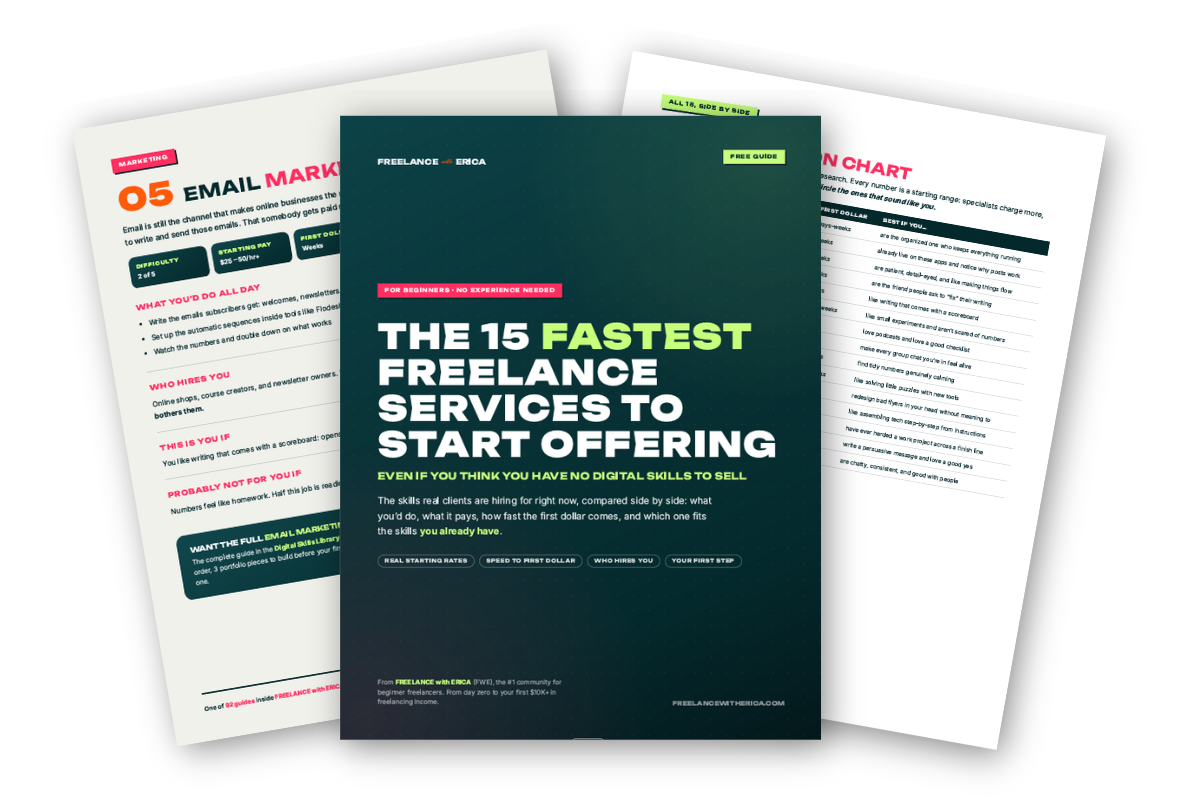
Get The 15 Fastest Freelance Services to Start Offering: all 15 compared side by side, with a clear read on which one fits the skills you already have.
📬 Go check your email!
Your free guide is on its way to your inbox right now. If it plays hide-and-seek, peek in the spam or promotions folder.
Level up later
Skills that stack with electronics work
Doing more of the product makes you rare and raises your rate: the board, the housing, the manufacturing handoff. Stacking is where the real money is.
3D Modeling & CAD
Enclosure and product CAD pairs naturally with electronics design. A person who can do the board AND the housing is rare and valuable.
Read the Guide →Energy & Mechanical
Electromechanical products need both disciplines; mechatronics sits right at this intersection.
Read the Guide →Contract Manufacturing
A finished PCB design has to be manufactured. Understanding the make-it side makes your electronics work far more valuable.
Read the Guide →Electrical & electronics engineering FAQ
Can I freelance electronics design with no degree?+
For PCB design, firmware, and electronics design: yes, because none of that requires a license, just real skill. And that skill has to be real. You need working boards and shipped firmware you can point to, which takes a long time to build whether you get there through a degree or serious self-taught practice. For licensed power-systems work, you do need a PE.
How much do freelance electrical and electronics engineers make?+
Specialized electronics and electrical work commonly runs $50–200/hr depending on the niche and proof of skill. Skilled-but-newer PCB/firmware freelancers may start around $30–60/hr while building a track record. These rates go to people who can demonstrably deliver working hardware.
What's the realistic on-ramp if I'm technical but not an EE?+
PCB layout and schematic capture, often under a more experienced engineer's direction, plus embedded firmware if you can code. Build real projects, working boards, shipped firmware, until you have proof, then portfolio-driven Upwork work becomes realistic.
Will AI replace electronics engineers?+
Not the core. AI helps with firmware, documentation, and some design exploration, but it can't validate a physical circuit or take responsibility for hardware that has to ship and not fail. The verification and judgment stay human.
Do I need a license like structural engineers do?+
Only for the power-systems and building-electrical side. That part is PE-gated, just like structural engineering. The electronics, PCB, and embedded side just needs the skill, no license required. Know which lane you're in before you start.
Get started, $9/mo
Ready for the full breakdown?
The complete electrical & electronics guide is one piece of the starting tier. Everything on the right comes with it.
- The full Digital Skills Library, all 90+ guides
- The Find Your Freelance Ready Skills training
- The FWE community chat forum
- Weekly co-working calls
- Five monthly contests for cash
- The monthly accountability challenge
- The proposal tracker that comes with it
- Live guest trainings