Digital Skills Library · Engineering & Architecture
How to become a freelance interior & trade show designer
What freelance interior and trade show designers charge in 2026, the booth and room services clients hire for, and the beginner's path from no experience to your first paying client.
Difficulty
3 of 5
Learnable online; booth logistics and layout raise the bar past simple room styling
First dollar
Medium
Build a small portfolio of mock rooms or booth concepts first, then weeks to a first client
Startup cost
Low-medium
Free and cheap design tools get you started
AI-friendliness
Medium
AI helps with concepts and copy; the eye and sourcing stay human
Demand
Steady
E-design and event/booth design both keep growing
Start here
Go from curious to freelance-ready
This page shows you what freelance interior and trade show design work is like: the pay, the services, and whether it fits you. The full guide inside the Digital Skills Library walks you through getting started: what to learn first, where to learn it, and how to practice until you're ready to offer it as a freelance service. Here's what unlocks for this skill:
- 🔒 A 4-week learning plan: room and booth design fundamentals, in order
- 🔒 Hand-picked courses and videos, with the why behind every pick
- 🔒 The layout, rendering, and mood-board tools to set up on day one
- 🔒 2-3 presented projects, room or booth, you can build before you have a single client
- 🔒 Ready-to-use AI prompts for sourcing and client presentation
- 🔒 Which skill to add next, and why it raises your freelance rate
- 🔒 The big-picture map: mood boards, full rooms, then booths and small commercial work
- 🔒 Updates whenever the tools and the market change
The skill, straight
What does an interior & trade show designer do?
Interior and trade show design is the work of making a space feel intentional: a living room that finally flows, a short-term rental that photographs like a magazine, a trade show booth that pulls people in off the aisle. Most of this happens remotely: you take photos, measurements, or a booth's dimensions and a budget, then hand back a mood board, a layout, and a plan the client can execute. AI can now spit out a rough visual in seconds, and that just makes a human with real taste and spatial judgment more valuable than ever.
01
Turn photos or a booth spec into a real design
Measurements and a few phone photos, or a booth's dimensions, become a full layout, palette, and plan. No site visit required.
02
Hand clients something they can execute
A shoppable product list or a vendor-ready booth layout: something a client can hand straight to a vendor or a shopping cart and use right away. That's the difference between inspiring and useful.
03
Make a space work under real constraints
A room has to flow; a booth has to stop foot traffic in a 10-foot aisle. A design that looks good but ignores the constraint has failed.
Is interior & trade show design right for you?
Yes
You have a strong sense of color, style, and how a space should feel and flow, and you enjoy curating and arranging. If you're "the friend who helps everyone decorate," that instinct is the job.
Maybe
You have the taste but freeze at software. Floor-plan and render tools are learnable, and you can start with mood boards alone while you build that muscle.
No
You're aiming straight at licensed architectural work or large commercial builds with no design background. That's the gated lane; start in e-design and grow toward it.
Best for people with a genuine eye for space, color, and styling who love making rooms (or booths) feel right. If you've ever rearranged a room three times until it felt right, that instinct is the core of the job.
Quick heads-up before you dive in: in some regions the title "interior designer" is regulated and requires credentials, especially for work involving construction or building codes. E-design, styling, and trade show / event booth design don't require a license, and that's the lane this guide is all about.
Pick a lane
Interior & trade show services you can sell
Clients hire you to fix one specific problem, so say it plainly. "I design trade show booths that stop foot traffic" beats "I can design any space" every single time.
Your Free Unlock
Get the full member version of this guide, free
Everything on this page is the short version. The member guide goes all the way: the step-by-step learning plan, the tools, the AI prompts, and the practice projects that build real skill. Every person gets one guide free, and it can be this one.
Unlock This Guide Free → One Free Guide Per PersonAlready unlocked a guide, or already a member? Log in here.
How the money grows
The interior & trade show service ladder
Four steps from your first mood board to an ongoing styling partnership. These prices are market averages, and premium freelancers charge well beyond them.
Starter
Single room e-design
$200–500/room
One mood board plus a shoppable product list for a single room. Bounded, remote, and the classic beginner on-ramp.
Core
Full room concept
$500–1,200/room
Mood board, layout, a render, and a complete sourced shopping list the client can execute themselves.
Premium
Multi-room or small commercial
$1,500–5,000+/project
A whole-home concept, a rental refresh, or a small retail / booth design with layout, renders, and sourcing.
Retainer / repeat
Staging & styling partner
$800–3,000+/mo
Ongoing styling for a realtor, a rental-property owner, or an event company that needs spaces designed on a schedule. Everyone starts hourly; retainers come once your rate and portfolio are built (I teach them in my final course).
Who buys interior & trade show design?
Anyone with a room or a booth that isn't working, and no budget for an in-person designer. You've heard every one of these:
People hire a freelance designer when a space or a booth already isn't working for them, and they need someone who can make it feel right without a site visit. A move, a renovation, an upcoming trade show, or a listing that needs to book or sell faster forces the question.
The numbers
How much do interior & trade show designers make?
Let's rip the band-aid off: your very first room design might sell for as little as $200, and yes, that's rough for the hours it takes. The ranges below are an example of what average freelancers charge on Upwork in 2026, and they're a good reference while you're starting out. Inside FREELANCE with ERICA, you'll learn how to position your services for premium pricing over time.
Beginner
$18–35/hr or $200–500/room
A portfolio of mock rooms or booth concepts, basic software, and the confidence to package per project.
Intermediate
$35–75/hr or $500–1,200/room
Renders, a niche like rentals or booths, reviews, and a repeatable process.
Advanced
$75–150/hr+
Full-service projects, commercial and event work, and project pricing that ignores the clock.
Here's the real jump: stop selling mood boards and start selling outcomes. "A short-term rental designer who books more nights," or "a booth designer who stops foot traffic," sells a result, and clients pay more for a result than a service list. Every number above ends in a plus because there's real room to grow past it. 🛋️
One more thing, and I want you to really hear this: those ranges are averages, and averages have zero say over what you get to charge someday. As you work through my courses, you'll learn how to stack skills and position your services, so you can become a premium freelancer who charges above the market. Here's my own example: I'm a sales copywriter. Look up copywriters on Upwork and you'll see averages between $10 and $75 an hour. I regularly charge over $200 an hour for the same skill, because there are clients who happily pay for real expertise, and you only need a handful of them.
Free guide
Not sure this is your lane?
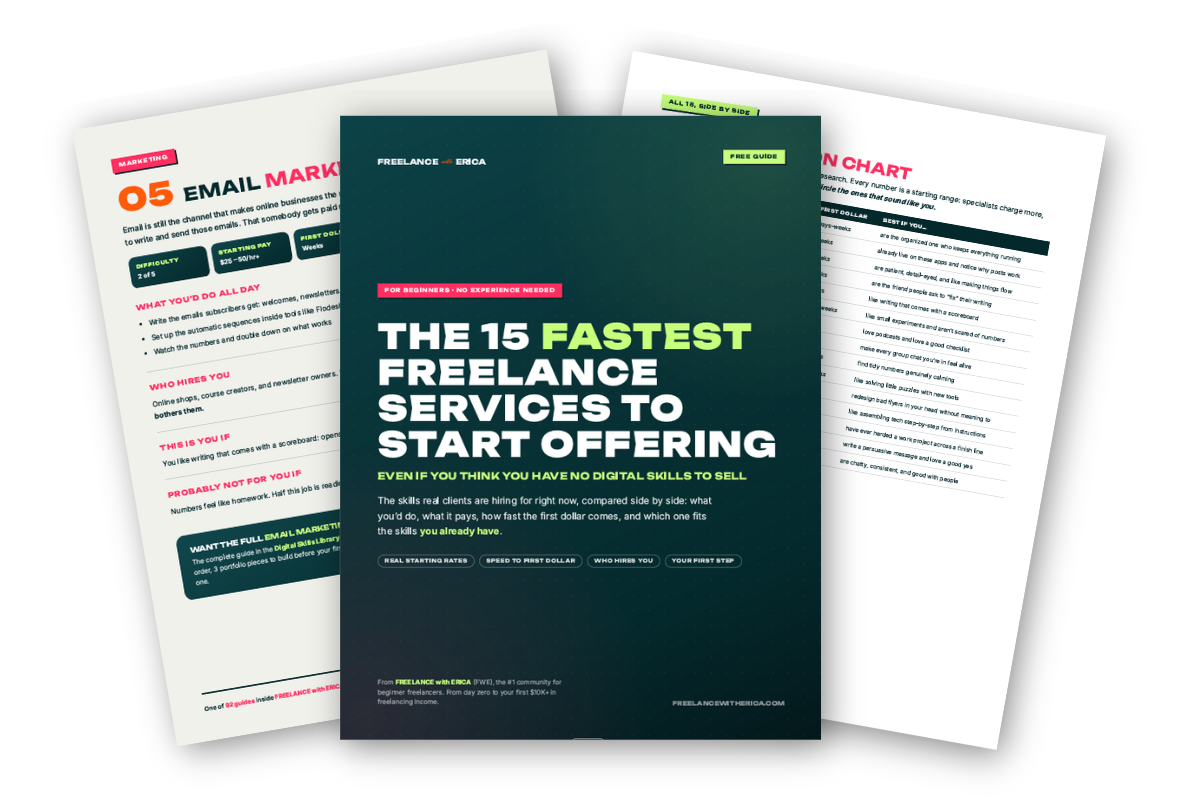
Get The 15 Fastest Freelance Services to Start Offering: all 15 compared side by side, with a clear read on which one fits the skills you already have.
📬 Go check your email!
Your free guide is on its way to your inbox right now. If it plays hide-and-seek, peek in the spam or promotions folder.
Level up later
Skills that stack with this work
The highest-earning freelancers combine two or three skills, so one design project turns into steady monthly work.
Graphic Design
Mood boards, presentation decks, and booth signage are graphic-design work. The two skills share the same tools and double your sellable pieces.
Read the Guide →Social Media Management
You're already visual, so managing social for a designer or a furniture brand is an easy add, and it turns one project into steady monthly work.
Read the Guide →3D Modeling & CAD
Learning floor plans and 3D renders is the fastest way to raise your rate here. Once you can hand a client a full render of their actual room or booth, they pay more for it.
Read the Guide →Interior & trade show design FAQ
Can I do interior or trade show design freelance without a degree?+
For the e-design, styling, and booth-design lane, yes. Online interior design and event/booth design have no universal degree or license requirement, and remote platforms and event clients hire on portfolio and taste. Licensed architectural work, structural changes, and large commercial builds are a different, gated lane, so start here and grow toward the rest.
How much do freelance interior and trade show designers make online?+
Beginners realistically earn around $18–35/hr or roughly $200–500 per room, intermediate designers with renders and a niche earn $35–75/hr or $500–1,200 per room, and experienced designers with full-service, commercial, and event work charge $75–150/hr+ or price by project. Where you land in those ranges comes down to how you position yourself.
What software do I need to learn?+
You can start with mood boards alone using Canva or a mood-board app. To raise your rate, add a floor-plan and 3D tool such as SketchUp (a free version exists) or a dedicated interior-design platform. Renders are the single upgrade that most increases what clients will pay.
Is this a good skill in the age of AI?+
Mostly yes, with eyes open. AI can generate rough room or booth visuals, which raises the floor on cheap mock-ups. The defensible work is real spatial judgment, accurate sourcing within a real budget, and the taste a client trusts, none of which AI reliably delivers.
How do I get my first client?+
Build 2–3 mock projects first (a redesigned room, a mock booth concept), then use Upwork to find bounded jobs like "design my living room," "style my Airbnb," or "trade show booth concept." A polished sample plus a clear per-project package gets a beginner hired faster than any credential.
Get started, $9/mo
Ready to learn the how?
The complete interior & trade show design guide is one piece of the starting tier. Everything on the right comes with it.
- The full Digital Skills Library, all 90+ guides
- The Find Your Freelance Ready Skills training
- The FWE community chat forum
- Weekly co-working calls
- Five monthly contests for cash
- The monthly accountability challenge
- The proposal tracker that comes with it
- Live guest trainings