Digital Skills Library · Engineering & Architecture
Can you freelance in physical sciences?
The straight answer, real 2026 rates ($20–250/hr+ depending on the lane), and the accessible adjacent work (literature research, data cleanup, technical writing) if you're drawn to this world but don't have a science degree.
Difficulty
5 of 5
A relevant degree and domain expertise expected; the adjacent support work is closer to 2-3 of 5
First dollar
Slow for the core lane
Faster for the adjacent research, data, and writing support work
Startup cost
Low tools, high knowledge
The real barrier is years of education, not equipment
AI-friendliness
High, two-edged
AI speeds routine literature/analysis work, and raises the premium on real expert judgment
Demand
Niche, but durable
Real demand, but concentrated among credentialed scientists
Start here
Get the real picture
This page shows you what freelance physical sciences work is like: the pay, the services, and whether it fits you. The full guide inside the Digital Skills Library splits cleanly in two: what applies if you have a real science degree, and what applies if you don't, so you know exactly which door is yours. Here's what unlocks for this guide:
- 🔒 The straight-up split up front: what applies if you have a real science degree, and what applies if you don't
- 🔒 The real, accessible adjacent lane: literature research, data cleanup, and technical writing support
- 🔒 A clear pointer to the Data Analysis & Testing, Content Writing, and Data Entry & Research guides, where the deeper tools and packaging content live
- 🔒 How trained scientists package real domain expertise into freelance offers and price specialist consulting
- 🔒 Ready-to-use AI prompts for literature research, data cleanup, and client communication
- 🔒 How the knowledge builds, and how it eventually unlocks the core consulting lane
- 🔒 The big-picture map: where this leads for a trained scientist, and where it leads for everyone else
- 🔒 Updates whenever the market and research tools change
The skill, straight
What does physical sciences consulting look like?
Freelance physical sciences means trained scientists, physicists, chemists, materials and earth scientists, doing consulting, analysis, modeling, and technical review for businesses, labs, and product teams. It's specialized work and it pays well at the top, but you can't learn your way into that core lane with a weekend course. That side is gated by a real degree and years of domain expertise. What's open to a beginner is the work around the edges: research, data, and writing support for the scientists doing the core work.
01
Answer a question only real training can answer
Is this physically possible, does this data mean what it looks like, is this methodology sound, the questions a degree backs with real judgment.
02
Turn raw research into something a business can use
Lab data, literature, and experiments become a clear recommendation a non-scientist can act on.
03
Carry expert judgment a client can't verify themselves
A startup or product team is trusting expertise built over years, the kind AI or a quick search can't fake.
Is physical sciences right for you?
Yes
You have a degree in a physical science (physics, chemistry, materials, geology, and similar) and real domain experience. Freelancing here is about packaging expertise you already earned.
Maybe
You're organized, comfortable with data and research, or a capable writer who can handle technical material. Your realistic entry is the support layer: research, data, and technical writing.
No
You have no scientific training and hope to consult on science anyway. Clients hire on credentials here, full stop; point that energy at the data, research, or writing lanes instead.
Best for trained scientists. For everyone else, the research, data, and technical-writing on-ramp is a real skill worth building on its own.
Pick a lane
Science services you can sell
Clients aren't buying "science." They're buying a specific problem solved: a clean literature summary, a structured dataset, a clear answer to "is this physically possible."
Your Free Unlock
Get the full member version of this guide, free
Everything on this page is the short version. The member guide goes all the way: the step-by-step learning plan, the tools, the AI prompts, and the practice projects that build real skill. Every person gets one guide free, and it can be this one.
Unlock This Guide Free → One Free Guide Per PersonAlready unlocked a guide, or already a member? Log in here.
How the money grows
The science service ladder
Four steps from the research-and-writing on-ramp to a standing science advisory built on years of expertise. Every rung above the first requires a relevant degree. These prices are market averages, and premium freelancers charge well beyond them.
Adjacent (accessible)
Research & data support
$20–45/hr
Literature research, data entry and cleanup, citation formatting, and technical writing support for a scientist's project. The realistic beginner-adjacent entry.
Core (degreed)
Analysis & consulting
$45–90/hr
Scientific analysis, lab-data interpretation, methodology review, and technical reports, for someone with a relevant degree.
Premium (specialist)
Expert consulting
$90–250/hr+
PhD-level domain consulting: R&D guidance, materials selection, modeling, and expert review. Built on deep specialization.
Retainer / advisory
Ongoing science advisor
Retainer or advisory pricing, high
Ongoing technical advisory for a startup, lab, or product team that needs a scientist on call. Everyone starts hourly; retainers come once your rate and portfolio are built (I teach them in my final course).
Who hires physical sciences consultants?
Anyone who needs a scientific question answered reliably and doesn't have that expertise in-house. You've heard every one of these:
People hire freelance help here for a new R&D project, a product feasibility question, a research deadline, a grant submission, or a publication that needs to get the science right. The full consulting work needs the degree, and that's exactly why it pays at the top of the scale.
The numbers
How much do science consultants make?
Here's the number nobody loves: without a science degree, the adjacent research and data work starts at regular beginner-freelancer pay, no PhD premium attached. The ranges below are an example of what average freelancers charge on Upwork in 2026, and they're a good reference while you're starting out. Inside FREELANCE with ERICA, you'll learn how to position your services for premium pricing over time.
Beginner
$20–45/hr
Research, data, or technical-writing support skills, no science degree required.
Degree needed
$45–90/hr
A relevant degree, the ability to analyze and interpret, and early client trust.
Advanced
$90–250/hr+
Advanced degree, deep domain expertise, and a reputation clients pay a premium for.
Scientific training is what unlocks the bigger checks here. If you want to start earning now, the research, data, and technical-writing support lane is where to begin.
One more thing, and I want you to really hear this: those ranges are averages, and averages have zero say over what you get to charge someday. As you work through my courses, you'll learn how to stack skills and position your services, so you can become a premium freelancer who charges above the market. Here's my own example: I'm a sales copywriter. Look up copywriters on Upwork and you'll see averages between $10 and $75 an hour. I regularly charge over $200 an hour for the same skill, because there are clients who happily pay for real expertise, and you only need a handful of them.
Free guide
Not sure this is your lane?
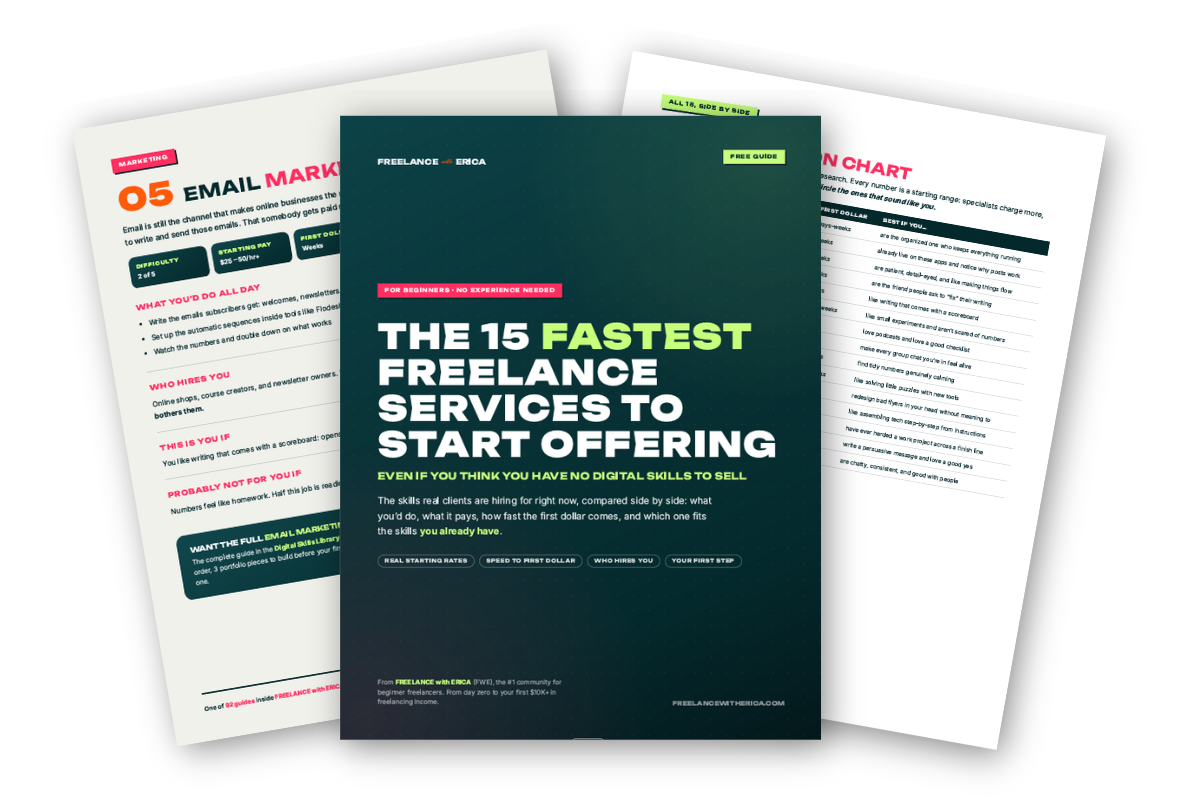
Get The 15 Fastest Freelance Services to Start Offering: all 15 compared side by side, with a clear read on which one fits the skills you already have.
📬 Go check your email!
Your free guide is on its way to your inbox right now. If it plays hide-and-seek, peek in the spam or promotions folder.
Level up later
Skills that stack with this work
For everyone drawn to this field, these are your real adjacent lanes. For beginners without a science degree, Data Analysis & Testing is where you start.
Data Analysis & Testing
Data analysis is the most transferable, accessible adjacent to science work. A beginner with spreadsheet and stats skills can support research.
Read the Guide →Content Writing
Technical and science writing turns research into readable content, a learnable lane that lets you work near science without a science degree.
Read the Guide →Data Entry & Research
Literature research, citation work, and dataset cleanup are real support services a scientist will outsource, the genuine beginner doorway.
Read the Guide →Physical sciences FAQ
Can I freelance in physical sciences with no degree?+
Not in the consulting sense, no. Clients hire freelance scientists to interpret data, guide R&D, and review methodology, and they're hiring the credential as much as the person, so a relevant degree is basically required. What a non-scientist can do is the adjacent support work: literature research, data cleanup, citation formatting, and technical writing.
Is physical sciences a good freelance skill for a beginner?+
Nope, not from scratch. This is a degreed specialist field, so it's a great freelance path if you already trained as a scientist. If you're a beginner who loves the subject, come in through the data-analysis, research, and writing lanes. Those you can learn your way into.
How does AI affect this field?+
Two ways. AI now handles a lot of the routine literature search and basic analysis, so the easy support tasks are worth less than they used to be, don't build a whole freelance business on those alone. At the same time, AI still can't replace real expert judgment, which makes credentialed specialists more valuable than ever. Figure out which lane you're in before you plan around it.
What's the accessible way in if I love science?+
Offer the support layer: literature research, data entry and cleanup, citation work, and technical or science writing. Pair it with data-analysis and writing skills. You work near the science you love and earn while you decide whether a formal science path is for you.
Get started, $9/mo
Ready for the honest breakdown?
The complete physical sciences guide is one piece of the starting tier. Everything on the right comes with it.
- The full Digital Skills Library, all 90+ guides
- The Find Your Freelance Ready Skills training
- The FWE community chat forum
- Weekly co-working calls
- Five monthly contests for cash
- The monthly accountability challenge
- The proposal tracker that comes with it
- Live guest trainings