Digital Skills Library · Legal
How to become a freelance legal researcher
What freelance legal researchers charge in 2026 ($23–60/hr common), the services attorneys hire for, and the real, no-law-degree path from no freelance experience to your first attorney client.
Difficulty
3 of 5
No law degree required; the real bar is rigor and a grasp of how legal authority works
First dollar
Moderate
With a clear offer and one strong sample memo, weeks to a couple of months is realistic
Startup cost
Low
Free case-law databases get you all the way to a first paid job
AI-friendliness
Medium-high
AI accelerates the search and summary; you verify every citation against the real source
Demand
Steady
Attorneys always need research hands, and verification grows more valuable as AI spreads
Start here
Go from curious to freelance-ready
This page shows you what freelance legal research work is like: the pay, the services, and whether it fits you. The full guide inside the Digital Skills Library walks you through getting started: what to learn first, where the not-legal-advice line sits, and how to practice until you're ready to offer it as a freelance service. Here's what unlocks for this skill:
- 🔒 The not-legal-advice boundary, spelled out clearly: what you find and summarize, and what stays the attorney's job
- 🔒 A real learning path: how legal authority works, finding the law, reading a case, verification and citation-checking, writing a findings memo
- 🔒 Hand-picked free case-law databases and resources for learning the craft
- 🔒 3 practice drills that build a real sample before you have a single client
- 🔒 Ready-to-use AI prompts for research and summarizing, with verification guardrails
- 🔒 How to turn one research task into standing monthly support
- 🔒 The big-picture map: from a single findings memo to a trusted standing research partner
- 🔒 Updates whenever the tools and the market change
The skill, straight
What does a freelance legal researcher do?
A freelance legal researcher finds the raw material attorneys build their work on: the controlling cases, the relevant statutes, the regulations and precedent on a specific question. You don't need a law degree to start, you find and summarize what the law says; the attorney interprets and applies it. AI speeds the search; the verification stays human.
01
Find the raw material attorneys build their work on
The controlling cases, the relevant statutes, the regulations and precedent on a specific question. You find and summarize; they advise and decide.
02
Carry a verification discipline AI can't replace
AI hallucinates citations and invents cases that don't exist, and an attorney who files a fake one gets sanctioned. Verifying every source against the real database is the value.
03
Stay on the "here's what I found" side of a bright line
You never tell a client what the law means for them, whether they'll win, or what to do. That line is what keeps this lane open.
Is legal research right for you?
Yes
You're thorough, you enjoy digging until you find the actual answer, you read carefully, and you take "is this source real and current?" seriously. Ex-students, writers, librarians, researchers of any kind, paralegals-in-training, and detail-obsessed people thrive here.
Maybe
You're impatient or you skim. Legal research punishes carelessness, a missed case or a stale statute is a real problem, but thoroughness is a habit, and it's learnable if you're willing.
No
You want to advise people on the law or argue cases. That's lawyering. It requires a license, and this lane is built to stay separate from it.
Best for thorough, curious, detail-driven people who love finding the right answer, no law degree required. If you've ever gone down a research rabbit hole for fun, that instinct is the job.
Pick a lane
Legal research services you can sell
You don't sell "legal research" in the abstract. You sell specific, bounded work an attorney already knows they need. "I find the controlling authority on X in Y jurisdiction" wins against "I can look things up."
Your Free Unlock
Get the full member version of this guide, free
Everything on this page is the short version. The member guide goes all the way: the step-by-step learning plan, the tools, the AI prompts, and the practice projects that build real skill. Every person gets one guide free, and it can be this one.
Unlock This Guide Free → One Free Guide Per PersonAlready unlocked a guide, or already a member? Log in here.
How the money grows
The legal research service ladder
Four steps from a single research task to a standing monthly research partnership. These prices are market averages, and premium freelancers charge well beyond them.
Starter
Single research task
$50–200+ per task
Find the controlling cases or statutes on one narrow question and deliver a short findings memo. Bounded, fast, low-risk for a first-time attorney client.
Core
Research memo
$150–600+ per memo
A full research memo on a legal question: the relevant authority, organized and summarized, for the attorney to interpret and apply.
Premium
Deep-dive research package
$600–2,500+ per project
Comprehensive research on a complex matter: multiple issues, jurisdictional comparison, a case-law survey. The heavy lifting behind a brief.
Retainer
Ongoing research partner
$800–3,000+ per month
Standing research support for a solo attorney or small firm, the steady hands they call whenever a question comes up. Everyone starts hourly; retainers come once your rate and portfolio are built (I teach them in my final course).
Who hires freelance legal researchers?
Anyone who needs case law dug up and can't spare the hours. You've heard every one of these:
People hire a freelance legal researcher the moment a looming brief deadline, a new matter, a busy season, or a solo attorney simply hitting the wall on hours. That last one is constant, which is why this lane has steady demand.
The numbers
How much do legal researchers make?
Somewhere out there is an attorney trying to hire a legal researcher for $23/hr, hoping you'll treat case law like beach reading. That's the bottom of this market, and even there it takes real skill to do well. The ranges below are an example of what average freelancers charge on Upwork in 2026, and they're a good reference while you're starting out. Inside FREELANCE with ERICA, you'll learn how to position your services for premium pricing over time.
Beginner
$20–35/hr+
A clear offer, one strong sample memo, and demonstrated accuracy.
Intermediate
$35–60/hr+
Repeat attorney clients, reviews, and reliability under deadline.
Advanced
$60–100/hr+
A specialty (a practice area or jurisdiction), a paralegal credential, and a reputation for research an attorney can file without re-checking.
Premium
$100–250/hr+
Researchers with a deep specialty and a track record so clean the attorney never double-checks it. That kind of trust commands premium rates.
Here's what moves the needle: trust. An attorney pays more for a researcher whose findings they don't have to re-verify, because you just saved them hours of liability-checking. That's also why every number above ends in a plus, your rate keeps climbing as more attorneys learn they can hand you the harder stuff.
One more thing, and I want you to really hear this: those ranges are averages, and averages have zero say over what you get to charge someday. As you work through my courses, you'll learn how to stack skills and position your services, so you can become a premium freelancer who charges above the market. Here's my own example: I'm a sales copywriter. Look up copywriters on Upwork and you'll see averages between $10 and $75 an hour. I regularly charge over $200 an hour for the same skill, because there are clients who happily pay for real expertise, and you only need a handful of them.
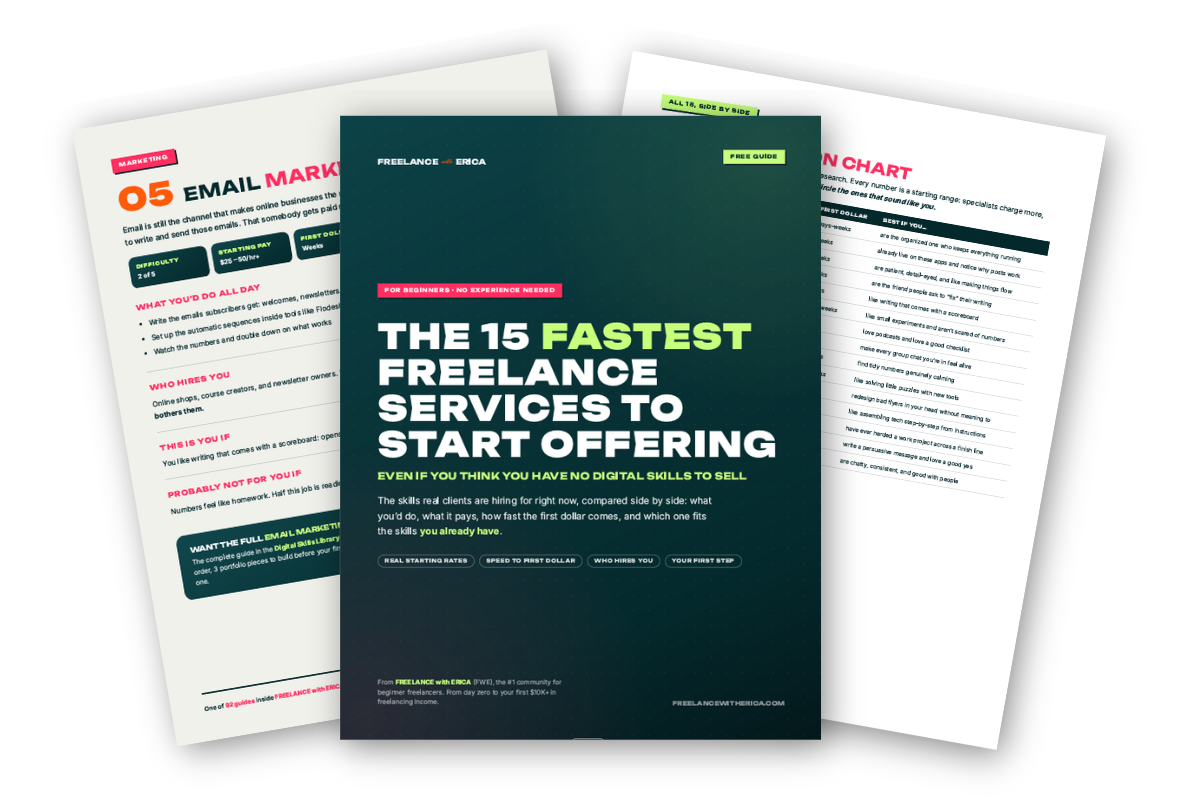
Free guide
Not sure this is your lane?
Get The 15 Fastest Freelance Services to Start Offering: all 15 compared side by side, with a clear read on which one fits the skills you already have.
📬 Go check your email!
Your free guide is on its way to your inbox right now. If it plays hide-and-seek, peek in the spam or promotions folder.
Level up later
Skills that stack with legal research
The highest-earning freelancers combine two or three skills, so one task turns into a fuller legal-support offer.
Paralegal / Legal Assistant
Research plus paralegal support is the natural bundle. An attorney who trusts your research happily hands you the file prep too, turning a task into standing monthly work.
Read the Guide →Content Writing
Legal research skills feed legal content writing (law-firm blogs, explainers). Same research muscle, a second income stream.
Read the Guide →Legal Transcription
Transcription gets you inside legal language and proceedings, an easy adjacent that pairs with research for fuller legal-support offers.
Read the Guide →Freelance legal research FAQ
Can I do freelance legal research without a law degree?+
Yes. Legal research is support work. It sits outside the practice of law, so it doesn't require a degree or license. What it requires is rigor: the ability to find the right authority, confirm it's current, and summarize it accurately, without advising anyone on what it means. Many successful freelance legal researchers are paralegals, ex-students, or career researchers who never went to law school.
How much do freelance legal researchers make?+
On Upwork the median is around $35/hr, with most between $23 and $60/hr, beginners start lower (roughly $20–35/hr) and experienced or specialized researchers reach $60–100/hr+. Established contract research firms bill $190/hr+ at the high end. These ranges are a starting point, and your positioning decides how far above them you go.
Isn't this just the practice of law?+
No, and the distinction is the whole point. You find and summarize what the law says. You never advise the client on what it means for them, whether they'll win, or what to do, that's legal advice and requires a license. Stay on the "here's what I found, you decide" side and you're doing legitimate support work.
Does AI make legal research obsolete?+
The opposite, if you're careful. AI speeds up searching and summarizing, but it hallucinates fake citations and misstates holdings, and an attorney who files a fake case gets sanctioned. The researcher who uses AI to move fast and verifies every source against the real database is more valuable than ever. Verification is a core part of what you sell.
How do I get my first legal-research client?+
Upwork is the fastest on-ramp: solo attorneys post for research support constantly. Build one strong sample findings memo (on a public legal question, using free case law), apply to bounded research jobs, and over-deliver on accuracy. One attorney who trusts your work tends to become standing monthly work.
Get started, $9/mo
Ready to learn the how?
The full legal research guide is one piece of the starting tier. Everything on the right comes with it.
- The full Digital Skills Library, all 90+ guides
- The Find Your Freelance Ready Skills training
- The FWE community chat forum
- Weekly co-working calls
- Five monthly contests for cash
- The monthly accountability challenge
- The proposal tracker that comes with it
- Live guest trainings