Digital Skills Library · Legal
How to become a freelance legal transcriptionist
What freelance legal transcriptionists charge in 2026 ($1.50-5/audio min, plus what that works out to per hour), the legal audio firms hire for, and the lowest-barrier path from no freelance experience to your first legal client.
Difficulty
2 of 5
No degree or license; the real bar is typing speed, accuracy, and patience
First dollar
Fast
Once your typing and accuracy are solid, weeks to a first paid job is realistic
Startup cost
Low
Free software gets you started; a foot pedal helps later, out of profit
AI-friendliness
Medium
AI gives you a rough draft, but a legal transcript still needs certified human accuracy
Demand
Steady
Law firms and court-reporting agencies always have overflow audio to transcribe
Start here
Go from curious to freelance-ready
This page shows you what freelance legal transcription work is like: the pay, the services, and whether it fits you. The full guide inside the Digital Skills Library walks you through getting started: what to learn first, the real effective-hourly math, and how to practice until you're ready to offer it as a freelance service. Here's what unlocks for this skill:
- 🔒 The real per-minute vs. effective-hourly math, so you always know what you're earning
- 🔒 A real learning path: build typing speed, learn legal formatting, master your tools, practice on real audio, an AI-assisted certified process
- 🔒 Hand-picked free typing-practice tools and resources for learning legal transcription specifically
- 🔒 4 practice drills that build real speed, accuracy, and one flawless sample before you have a single client
- 🔒 Ready-to-use AI prompts for drafting and formatting, with accuracy guardrails
- 🔒 How to turn one bounded transcript into standing weekly overflow work
- 🔒 The big-picture map: from a single transcript to a trusted standing transcription partner, and the climb beyond it
- 🔒 Updates whenever the tools and the market change
The skill, straight
What does a freelance legal transcriptionist do?
A freelance legal transcriptionist turns legal audio, depositions, hearings, attorney dictation, recorded interviews, into accurate, properly formatted text. There's no degree, no license, and no legal advice involved. AI gives you a rough draft; your certified accuracy is the product.
01
Turn legal audio into accurate, formatted text
Depositions, hearings, attorney dictation, recorded interviews. No degree, no license, no legal advice involved.
02
Guarantee accuracy AI alone can't certify
AI gives you a rough draft fast, but legal audio (multiple speakers, terminology, crosstalk, poor courtroom sound) is exactly where it struggles. Your correction and certification is the value.
03
Know the real math behind the per-minute rate
One audio hour takes several working hours. Your typing speed sets your real paycheck. The per-minute number is just the sticker price.
Is legal transcription right for you?
Yes
You type fast and accurately, you have a good ear, you're patient enough to get a hard passage exactly right, and you don't mind focused, heads-down work. Fast typists, detail-lovers, people who want a genuine low-barrier start, and anyone building toward bigger legal lanes thrive here.
Maybe
Your typing is slow or your accuracy slips under fatigue. Both improve with practice, and speed directly raises your effective hourly, so the practice pays off literally.
No
You can't tolerate repetitive, focused desk work, or you'd be unhappy with the effective hourly while you're building speed. Be honest with yourself: the per-minute rates look better than the early effective-hourly feels.
Best for fast, accurate, patient typists with good ears, the lowest-barrier entry into legal-adjacent work. If you can transcribe a tricky multi-speaker recording without losing accuracy, you've got the core skill.
Pick a lane
Legal transcription services you can sell
You sell accurate, properly formatted transcripts of specific kinds of legal audio. "I transcribe depositions and hearings, formatted to spec" wins against "I do transcription."
Your Free Unlock
Get the full member version of this guide, free
Everything on this page is the short version. The member guide goes all the way: the step-by-step learning plan, the tools, the AI prompts, and the practice projects that build real skill. Every person gets one guide free, and it can be this one.
Unlock This Guide Free → One Free Guide Per PersonAlready unlocked a guide, or already a member? Log in here.
How the money grows
The legal transcription service ladder
Four steps from a single transcript to a standing weekly overflow partnership. These prices are market averages, and premium freelancers charge well beyond them.
Starter
Single transcript
Per audio minute ($1.50–3+)
Transcribe one bounded piece of legal audio (a short hearing, a dictation, an interview) accurately and formatted to spec. Low-risk first job.
Core
Standard legal transcripts
$2–4/audio min, by complexity
Regular transcription of depositions, hearings, dictation, and interviews. Accurate, properly formatted, on a reliable turnaround.
Premium
Specialized / rush transcription
$4–5/audio min+ (rush adds more)
Complex multi-speaker proceedings, difficult audio, or rush turnarounds. Accuracy and speed under pressure command a premium.
Retainer
Ongoing transcription partner
$1,000–4,000+ per month by volume
Standing overflow transcription for a law firm or court-reporting agency, the reliable typist they send work to every week. Everyone starts hourly; retainers come once your rate and portfolio are built (I teach them in my final course).
Who hires freelance legal transcriptionists?
Anyone generating legal audio faster than they can type it. You've heard every one of these:
People hire a freelance legal transcriptionist the moment a deposition or hearing just happened, a backlog of dictation piles up, or a court reporter has more audio than time. That overflow is constant, which is why this lane has steady demand.
The numbers
How much do legal transcriptionists make?
Let's talk money, because transcription rates trip people up more than almost any other freelance skill. Legal transcription pays $1.50-5.00 per audio minute, and that looks great on paper until you remember one hour of audio takes several hours to type up well. Your effective hourly, what you earn for the time you put in, is the number that matters. The ranges below are an example of what average freelancers charge on Upwork in 2026, and they're a good reference while you're starting out. Inside FREELANCE with ERICA, you'll learn how to position your services for premium pricing over time.
Beginner
$15–25/hr effective
You're still building speed; an audio hour takes 3-4 working hours.
Intermediate
$25–40/hr effective
Faster, more accurate typing means fewer working hours per audio hour.
Advanced
$40–60/hr+ effective
Speed, specialization, certification, and rush work all lift the real rate.
Speed and accuracy are the real lever here. Doubling your typing speed roughly doubles your effective hourly at the same per-minute rate. That's why practice pays off, literally. Going direct to firms, skipping a platform's cut, pays even better.
One more thing, and I want you to really hear this: those ranges are averages, and averages have zero say over what you get to charge someday. As you work through my courses, you'll learn how to stack skills and position your services, so you can become a premium freelancer who charges above the market. Here's my own example: I'm a sales copywriter. Look up copywriters on Upwork and you'll see averages between $10 and $75 an hour. I regularly charge over $200 an hour for the same skill, because there are clients who happily pay for real expertise, and you only need a handful of them.
Free guide
Not sure this is your lane?
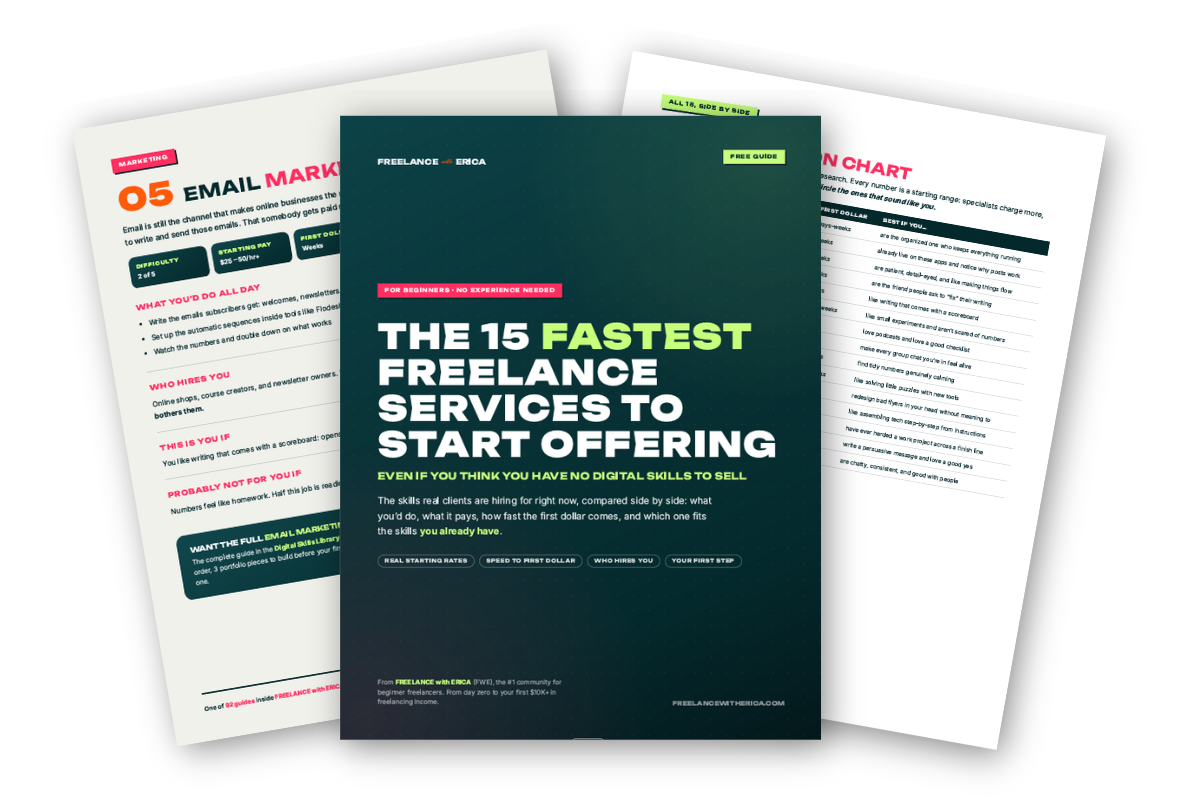
Get The 15 Fastest Freelance Services to Start Offering: all 15 compared side by side, with a clear read on which one fits the skills you already have.
📬 Go check your email!
Your free guide is on its way to your inbox right now. If it plays hide-and-seek, peek in the spam or promotions folder.
Level up later
Skills that stack with legal transcription
The highest-earning freelancers combine two or three skills, so one transcript turns into a fuller legal-support offer, or the climb into higher-paid work.
Paralegal / Legal Assistant
Transcription gets you fluent in legal language and proceedings, the perfect on-ramp to higher-paid paralegal support for the same clients.
Read the Guide →Legal Research
Both reward accuracy and legal fluency. Transcription pays the bills while you build toward research, which pays more per hour.
Read the Guide →General Transcription / Captioning
The same typing-and-accuracy skill serves general transcription and captioning, so you can diversify your income beyond legal audio.
Read the Guide →Freelance legal transcription FAQ
How much does legal transcription pay?+
Roughly $1.50–5.00 per audio minute (legal pays more than general because it's harder). But that's per audio minute, not per hour worked, and one audio hour takes several working hours, so your effective rate lands around $15–25/hr for beginners, rising to $40–60/hr+ as your speed and specialization grow. Going direct to firms, skipping a platform's cut, makes a big difference. These are positioning-based ranges, not guarantees.
Do I need a degree or certification for legal transcription?+
No. There's no degree or license requirement. A legal-transcription course or certification can help you learn the formatting and terminology and stand out, but you can start without one. The real requirements are typing speed, accuracy, a good ear, and patience.
Is legal transcription worth it given the low effective hourly?+
It depends on your goal. As a starting point, yes, it pays from week one, has no barriers, and teaches you legal language and proceedings. As a long-term ceiling, the effective hourly is modest, which is why I teach it as an on-ramp: many people use it to break into legal work, then climb into paralegal or research roles that pay far more per hour.
Will AI take over legal transcription?+
AI has commoditized easy, clean-audio transcription, but legal audio (multiple speakers, terminology, crosstalk, poor courtroom recordings) is exactly where AI struggles, and a legal transcript has to be certified accurate. The human who uses AI for a rough draft and then corrects, formats, and guarantees accuracy stays valuable. Raw AI output still needs a human correction pass before it counts as a legal-grade transcript.
How do I get my first legal-transcription client?+
Upwork and transcription companies are the fastest on-ramps. Build a sample transcript (transcribe a public legal recording accurately and format it to spec), then apply to bounded transcription jobs. Once you're fast and trusted, court-reporting agencies and firms send steady overflow, and that's where the reliable income lives.
Get started, $9/mo
Ready to learn the how?
The full legal transcription guide is one piece of the starting tier. Everything on the right comes with it.
- The full Digital Skills Library, all 90+ guides
- The Find Your Freelance Ready Skills training
- The FWE community chat forum
- Weekly co-working calls
- Five monthly contests for cash
- The monthly accountability challenge
- The proposal tracker that comes with it
- Live guest trainings