Digital Skills Library · Video & Audio
How to become a freelance videographer
What freelance videographers charge in 2026, what the gear-and-location side of the job really takes, and the beginner's path from no experience to your first paying client.
Difficulty
3 of 5
Camera and craft skills take real practice; the production side is very learnable
First dollar
Medium
A camera and a short reel first, then local and remote production work
Startup cost
Medium
The one gear-dependent lane in this library; a camera and basic kit
AI-friendliness
Medium-high
AI helps with post and b-roll, but real filming and directing stay human
Demand
Steady
Businesses, events, and creators constantly need real video shot well
Start here
Go from curious to freelance-ready
This page shows you what freelance videography work is like: the pay, the services, and whether it fits you. The full guide inside the Digital Skills Library walks you through getting started: what to learn first, where to learn it, and how to practice until you're ready to offer it as a freelance service. Here's what unlocks for this skill:
- 🔒 A 4-week videography learning plan: what to learn, in order
- 🔒 Hand-picked courses and channels, with the why behind every pick
- 🔒 The camera and audio kit to start with, before you overspend on gear
- 🔒 A short reel you can build before you have a single client
- 🔒 Ready-to-use AI prompts for shot lists, briefs, and client replies
- 🔒 Which skill to add next, and why it raises your freelance rate
- 🔒 The big-picture map: first short shoots, then produced video, then a recurring production partnership
- 🔒 Updates whenever the gear and the market change
The skill, straight
What does a videographer do?
A videographer films and produces video: products, events, interviews, ads, and content, then directs and shapes it into a finished piece. It's the on-camera, behind-the-lens craft the whole video economy runs on. Quick heads up: filming needs gear and usually happens somewhere physical, so pure filming is less work-from-anywhere than most skills in this library. Production and editing are way more remote-friendly, though, and they pair naturally with a filming practice.
01
Capture footage a client can use
Clean framing, steady shots, correct exposure, and clear audio, the basics that make raw footage usable at all. Miss any one of these and nothing after it matters.
02
Plan and direct the shoot, well beyond pointing the camera
Deciding what to film, in what order, and guiding people and moments into frame. This is the production half of the job, and it's where the real craft lives.
03
Turn raw footage into a finished, produced piece
Editing your own or someone else's footage into something a client can publish. This half of the job needs no camera and no location at all.
Is videography right for you?
Yes
You have, or will get, a camera, you notice good light and framing without being told, and you like the hands-on, physical side of the work. If you're already the one who fusses over how a shot looks, that instinct is the job.
Maybe
You like video but don't have gear yet, or the technical side feels new. Start with video editing, which needs no camera, then add filming once you have a reel and basic kit.
No
You want a fully remote, no-gear skill with no physical setup at all. Editing fits that better; filming needs a camera and, usually, a location.
Best for people with a camera and an eye for a good shot who want to shoot and produce video, well beyond editing someone else's. If you instinctively notice bad lighting or a boring angle, that instinct is the job.
Pick a lane
Videography services you can sell
Clients hire for a specific, named service, so it pays to pick one and get known for it. "I shoot and edit clean social video for local businesses" wins against "I do video stuff."
Your Free Unlock
Get the full member version of this guide, free
Everything on this page is the short version. The member guide goes all the way: the step-by-step learning plan, the tools, the AI prompts, and the practice projects that build real skill. Every person gets one guide free, and it can be this one.
Unlock This Guide Free → One Free Guide Per PersonAlready unlocked a guide, or already a member? Log in here.
How the money grows
The videography service ladder
Four steps from your first short shoot to a recurring production partnership. These prices are market averages, and premium freelancers charge well beyond them.
Starter
Short shoot or edit
$25–50+/hr
A short local shoot (a product, a social clip, an interview) or editing someone else's footage. A bounded first job.
Core
Produced video
$50–100+/hr
A complete short video: filmed, directed, and edited, for a brand, event, or creator.
Premium
Commercial production
$100–300+/hr
High-production ads, brand films, or multi-day shoots with a crew, real gear, and full post.
Retainer
Video production partner
$2K–10K+/mo
The recurring video partner for a brand or creator: content, events, and campaigns on a schedule. Everyone starts hourly; retainers come once your rate and portfolio are built (I teach them in my final course).
Who hires videographers?
Anyone who needs real video of a real thing and doesn't have someone in-house to shoot it. You've heard every one of these:
People hire a freelance videographer the moment a phone clip stops being good enough for what they're building, and the piece needs real, produced video to land. Usually right after a launch, an event, or a campaign forces the question.
The numbers
How much do videographers make?
Look up "videographer" on Upwork and you'll see a pile of rock-bottom day rates from people just trying to land any camera work at all. Good news: you don't have to compete on that end. The ranges below are an example of what average freelancers charge on Upwork in 2026, and they're a good reference while you're starting out. Inside FREELANCE with ERICA, you'll learn how to position your services for premium pricing over time.
Beginner
$25–50/hr+
A camera, basic skills, and a short reel, or day rates starting from $300.
Intermediate
$50–100/hr+
A niche, reviews, and full produced videos, or $90–200/hr on filming days.
Advanced
$100–300/hr+
Commercial production, crews, and steady monthly brand work, or $200–500/hr on senior commercial work.
Production quality and the clients you land are what move you up this ladder. "Videographer" sounds like anyone with a camera, so clients compare prices. "I shoot and produce branded video for local businesses" sounds like exactly one person, so clients compare fit. And every number above ends in a plus on purpose: it's a starting point.
One more thing, and I want you to really hear this: those ranges are averages, and averages have zero say over what you get to charge someday. As you work through my courses, you'll learn how to stack skills and position your services, so you can become a premium freelancer who charges above the market. Here's my own example: I'm a sales copywriter. Look up copywriters on Upwork and you'll see averages between $10 and $75 an hour. I regularly charge over $200 an hour for the same skill, because there are clients who happily pay for real expertise, and you only need a handful of them.
Free guide
Not sure this is your lane?
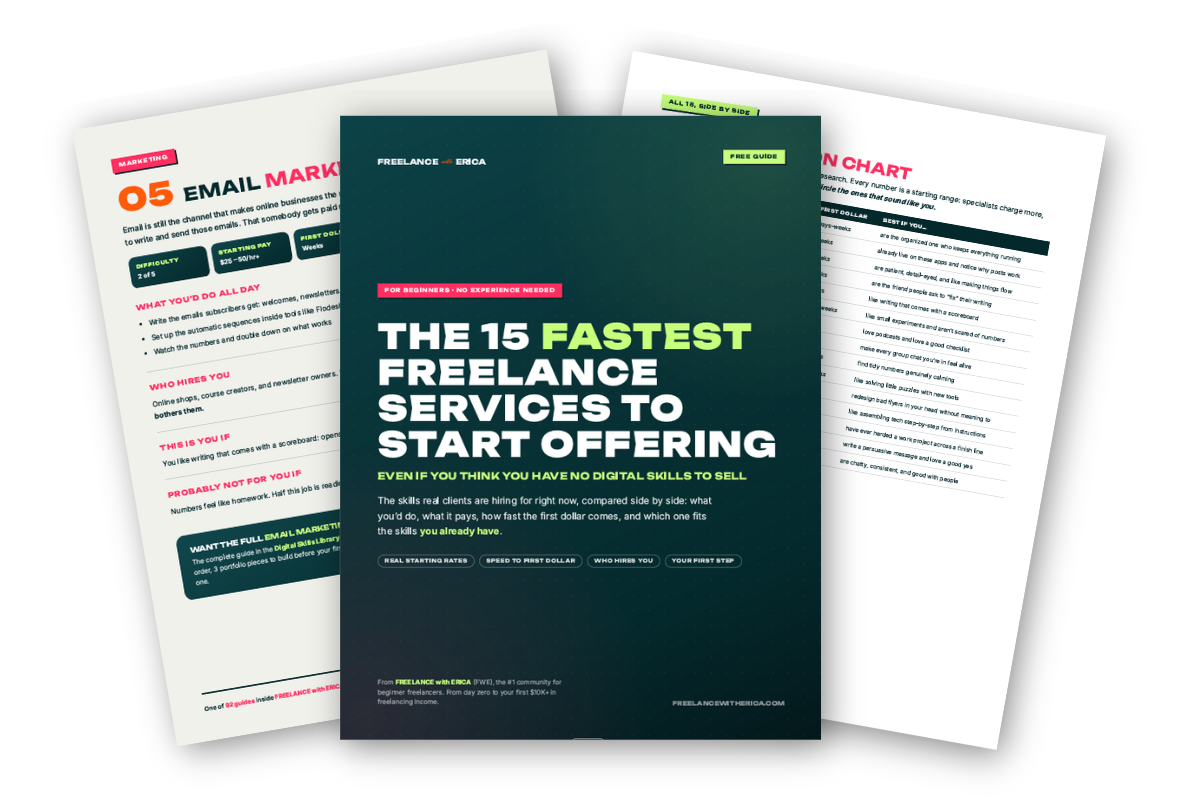
Get The 15 Fastest Freelance Services to Start Offering: all 15 compared side by side, with a clear read on which one fits the skills you already have.
📬 Go check your email!
Your free guide is on its way to your inbox right now. If it plays hide-and-seek, peek in the spam or promotions folder.
Level up later
Skills that stack with videography
The highest-earning freelancers combine two or three skills, so one small project turns into steady monthly work.
Video Editing
Editing is the more remote-friendly, steady half of this income. Shooting plus editing is the full package.
Read the Guide →Motion Graphics & Animation
Adding motion graphics to a produced video raises the production value and the price.
Read the Guide →AI Video
AI b-roll and tools extend what you can deliver without filming everything yourself, a modern production edge.
Read the Guide →Videography FAQ
Can I do videography as remote freelance work?+
Partly. Editing and remote production are fully remote; filming is local and gear-based. The smart play is editing as your remote income base, plus local and product shoots where you already have a camera.
How much do freelance videographers make?+
Beginners charge $25–50/hr or day rates from $300, mid-level videographers $50–100/hr ($90–200/hr on filming days), and senior commercial work $100–300/hr (up to $200–500/hr). Editing is often billed separately by the hour. These are positioning-based ranges, not guarantees.
What gear do I need to start?+
A camera (even a good phone or an entry mirrorless works to start), a basic microphone for clean audio, and simple lighting. This is the one lane in this library with a real gear cost, so start lean and reinvest as jobs pay for the next upgrade.
Is videography safe from AI?+
Filming and directing real people, products, and events is safe, AI cannot do either. AI helps with post-production and b-roll. Pair real filming with AI tools and editing, and you've got a setup built to last.
How do I get my first client?+
Upwork has "videography," "video production," and remote "video editing" jobs; local clients come through referrals and outreach. Build a short reel, start with product, social, or editing work, and grow into produced video from there.
Get started, $9/mo
Ready to learn the how?
The full videography guide is one piece of the starting tier. Everything on the right comes with it.
- The full Digital Skills Library, all 90+ guides
- The Find Your Freelance Ready Skills training
- The FWE community chat forum
- Weekly co-working calls
- Five monthly contests for cash
- The monthly accountability challenge
- The proposal tracker that comes with it
- Live guest trainings