Digital Skills Library · Writing
How to make money with freelance creative writing
Here’s where the money is in freelance creative writing in 2026 (brand storytelling, fiction-for-hire, game narrative), plus the beginner’s path from no experience to your first paying client.
Difficulty
3 of 5
Writing fiction is approachable; earning well from it is the real skill
First dollar
Slow–Med
Pure fiction is competitive; commercial creative work pays faster
Startup cost
Low
Your imagination and free tools are the whole kit
AI-friendliness
Medium
Generic AI fiction floods the low end, so a real, human voice stands out fast
Demand
Medium & shifting
Steady for commercial storytelling, thin and competitive for pure literary work
Start here
Go from curious to freelance-ready
This page shows you what freelance creative writing work is like: the pay, the services, and whether it fits you. The full guide inside the Digital Skills Library walks you through getting started: what to learn first, where to learn it, and how to practice until you’re ready to offer it as a freelance service. Here’s what unlocks for this skill:
- 🔒 A 4-week creative writing learning plan: what to learn, in order
- 🔒 Hand-picked courses and resources, with the why behind every pick
- 🔒 The creative writing tools to set up on day one
- 🔒 3 work samples you can build before you have a single client
- 🔒 Ready-to-use AI prompts for everyday creative writing tasks
- 🔒 Which skill to add next, and why it raises your freelance rate
- 🔒 The big-picture map: first Upwork job, then a niche, then steady monthly clients
- 🔒 Updates whenever the tools and the market change
The skill, straight
What does a creative writer do?
A freelance creative writer aims imagination at work with a real budget: brand stories, fiction-for-hire, game narrative, children's content. AI flooded the low end with generic fiction, which is exactly why an original voice and real emotional truth stand out more than ever. Clients notice, and they pay for it.
01
Point imagination at work that has a budget
Brands, games, and fiction apps all need real storytelling. You’re the one who aims a creative gift at a client who’ll pay for it.
02
Build a world or voice a client can’t build alone
A brand origin story, a game’s lore, a serialized chapter, each needs a specific, felt voice a generic template can’t fake.
03
Give a story the human truth AI can’t fake
AI flooded the low end with generic fiction. Original imagination and real emotional truth are exactly what a paying client is short on.
Is creative writing right for you?
Yes
You have stories in your head, you love character and world-building, and you’re open to aiming that craft at commercial work too: brands, games, fiction apps, right alongside your own art.
Maybe
You only want to write your own novel and nothing else. That’s a beautiful goal and a hard income. Pair it with commercial work that pays the bills.
No
You need fast, predictable income right now and have zero interest in the commercial side. Start with a higher-paying lane and write fiction on the side.
Best for storytellers and imaginative writers willing to aim their craft at work that pays. If you build whole worlds in your head for fun, the trick is pointing that at a client who needs it.
Pick a lane
Creative writing services you can sell
Clients pay for a specific commercial story, so it pays to pick a lane and get known for it. "I write serialized romance for fiction apps" wins against "I write stories."
Your Free Unlock
Get the full member version of this guide, free
Everything on this page is the short version. The member guide goes all the way: the step-by-step learning plan, the tools, the AI prompts, and the practice projects that build real skill. Every person gets one guide free, and it can be this one.
Unlock This Guide Free → One Free Guide Per PersonAlready unlocked a guide, or already a member? Log in here.
How the money grows
The creative writing service ladder
Four steps from your first small freelance project to steady monthly income. These prices are market averages, and premium freelancers charge well beyond them.
Starter
A short creative piece
$50–300+
A short story, a brand origin story, or product narrative. Bounded, fast, and a perfect first job.
Core
Commercial storytelling
$300–1.5K+
Brand narrative, fiction-for-hire, children’s stories, or card copy. The bread-and-butter work.
Premium
A narrative project
$1.5K–8K+
Game and interactive narrative, or a ghostwritten novella. Higher stakes, and higher pay.
Retainer
Ongoing storyteller
$1.5K–6K+ /mo
Recurring serialized fiction or a studio’s narrative work. Everyone starts hourly; retainers come once your rate and portfolio are built (I teach them in my final course).
Who hires creative writers?
Anyone whose product, brand, or app needs a story a template can't fake. You’ve heard every one of these:
People hire a freelance creative writer the moment they realize their brand, app, or game has a story problem no template or generic AI draft can solve. Usually right when a real budget appears.
The numbers
How much do creative writers make?
Let’s be real: if all you write is literary fiction and short story submissions, you’re fighting over pennies a word. Aim your writing at brands, games, and apps instead, and the math changes fast. The ranges below are an example of what average freelancers charge on Upwork in 2026, and they’re a good reference while you’re starting out. Inside FREELANCE with ERICA, you’ll learn how to position your services for premium pricing over time.
Beginner
$0.05–0.15/word+
A few samples and a commercial angle (brand stories, fiction apps), well beyond literary submissions alone.
Intermediate
$0.15–0.40/word+
A niche (kids’, games, brand), reviews, and proof you deliver on theme and on deadline.
Advanced
$0.40/word+ or $500-5K+
A reputation in a commercial niche, plus narrative or licensed projects at project pricing.
A commercial angle raises your rate here, more than talent ever will. "Freelance writer" sounds like everyone else, so clients compare prices. "I write serialized fiction for reading apps" sounds like exactly one person, so clients compare fit. And every number above ends in a plus on purpose: it's a starting point.
One more thing, and I want you to really hear this: those ranges are averages, and averages have zero say over what you get to charge someday. As you work through my courses, you’ll learn how to stack skills and position your services, so you can become a premium freelancer who charges above the market. Here’s my own example: I’m a sales copywriter. Look up copywriters on Upwork and you’ll see averages between $10 and $75 an hour. I regularly charge over $200 an hour for the same skill, because there are clients who happily pay for real expertise, and you only need a handful of them.
Free guide
Not sure this is your lane?
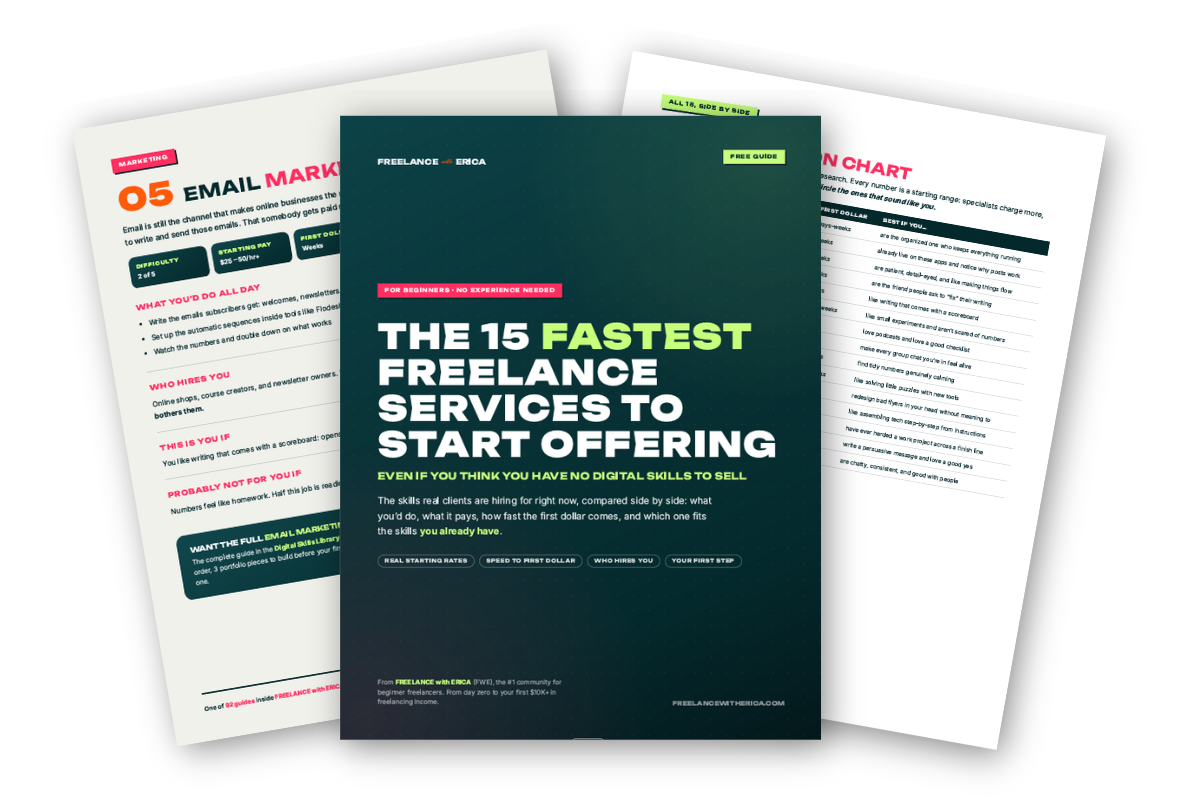
Get The 15 Fastest Freelance Services to Start Offering: all 15 compared side by side, with a clear read on which one fits the skills you already have.
📬 Go check your email!
Your free guide is on its way to your inbox right now. If it plays hide-and-seek, peek in the spam or promotions folder.
Level up later
Skills that stack with creative writing
The highest-earning creative writers combine two or three skills, so imagination turns into a real, repeatable income.
Ghostwriting
Fiction-for-hire and ghostwritten books are where creative skill earns real money, same craft, bigger budgets.
Read the Guide →Copywriting
Brand storytelling that also sells is the highest-paid use of a creative voice, add persuasion and your rate jumps.
Read the Guide →Scriptwriting
Story structure transfers directly to video and game scripts, which have far more budget than literary markets.
Read the Guide →Creative writing FAQ
Can you make a living with freelance creative writing?+
Yes, but usually not from pure literary fiction alone. The income comes from commercial creative work: brand storytelling, fiction-for-hire apps, game narrative, and children’s content. Treat literary fiction as craft and joy, and let commercial work pay the bills.
How much does freelance fiction pay?+
Literary markets pay roughly $0.05–0.12 per word, which is competitive and modest. Commercial creative writing (brand stories, serialized fiction) pays more, often $0.15–0.40+ per word or $500–5,000+ per project. Treat these as a starting reference, since real deals vary.
Is creative writing safe from AI?+
The generic low end isn’t, and you shouldn’t compete there. Original imagination, a distinct voice, and human emotional truth are exactly what AI can’t reliably produce, and that’s where the paying commercial work lives.
What’s the best way for a beginner to earn from creativity?+
Brand storytelling and fiction-for-hire apps. Brand work pays well and is beginner-accessible; fiction apps offer steady per-chapter income. Both let you write creatively and get paid now.
How do I get my first client?+
Upwork has brand storytelling, children’s writing, and game narrative jobs. Show two creative samples aimed at the commercial niche you want, and start there.
Get started, $9/mo
Ready to learn the how?
The full creative writing guide is one piece of the starting tier. Everything on the right comes with it.
- The full Digital Skills Library, all 90+ guides
- The Find Your Freelance Ready Skills training
- The FWE community chat forum
- Weekly co-working calls
- Five monthly contests for cash
- The monthly accountability challenge
- The proposal tracker that comes with it
- Live guest trainings