Your proposal has a job to do before you get the job
You find a listing that sounds like something you could do. You open a blank proposal. Then, somehow, the person who texts entire novels to a friend becomes a Victorian applicant requesting the honor of being considered for a position.
Dear Hiring Manager, I am writing to express my sincere interest…
I know. You’re trying to sound professional. You want them to take you seriously, especially when you’re new.
But the client is scrolling through a pile of applications, trying to figure out who understands the problem and can help them solve it. Your perfectly respectable introduction may sound almost identical to the perfectly respectable introductions above and below it.
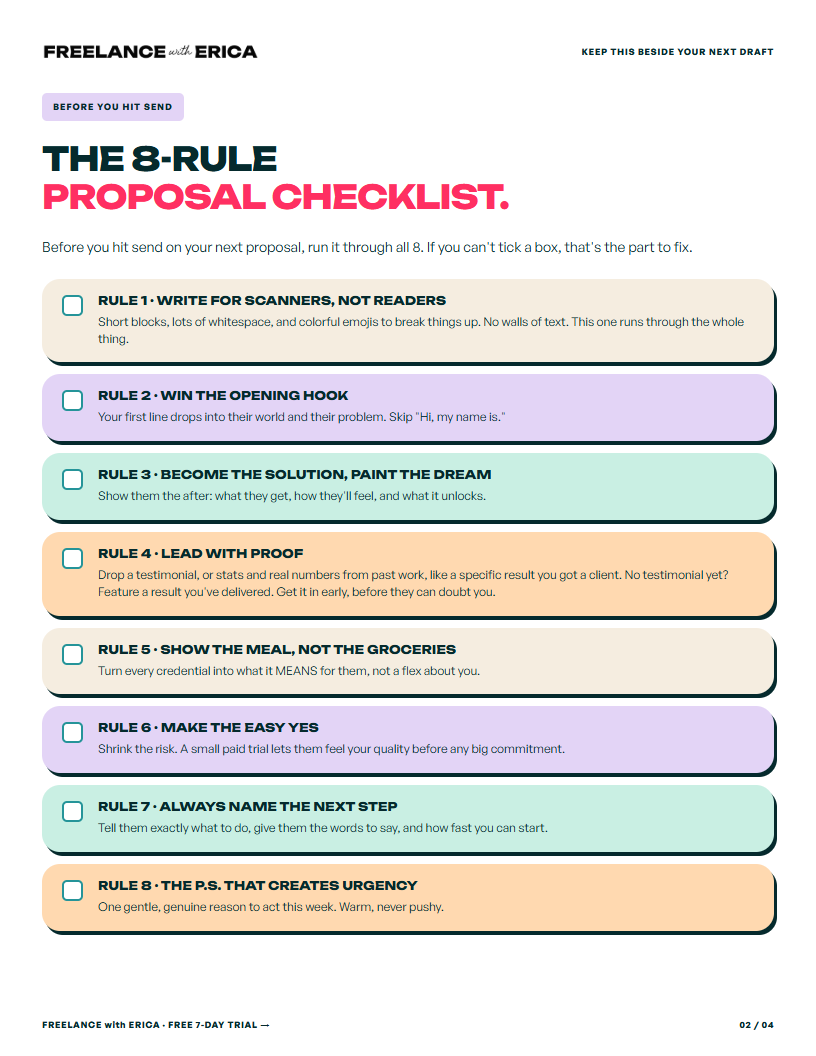
I’ve sent more than 600 proposals on Upwork. In this training, I walk through one of my own winning proposals and the eight rules behind it. The strategy is to make each part of your cover letter help the client make the next decision: open it, read it, believe you, and reply.
1. Write your Upwork cover letter for scanners
A wall of text asks a busy person to commit before you’ve given them a reason to care.
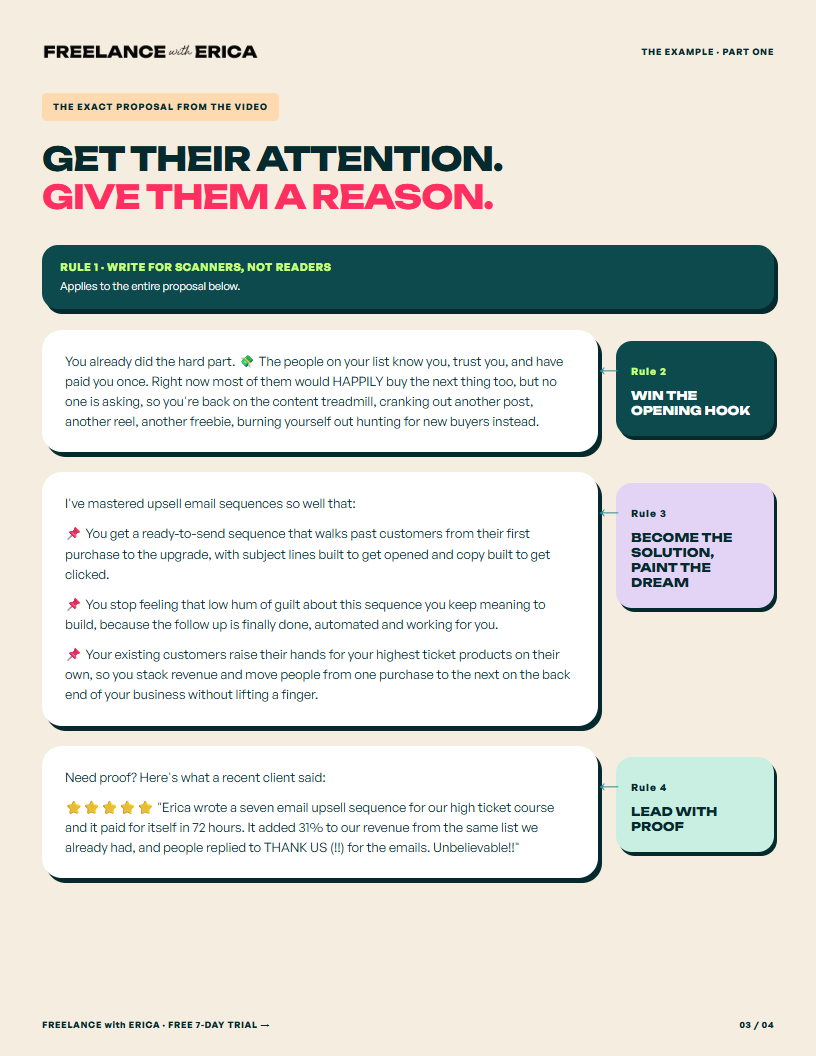
Use short paragraphs, white space, and a clear path through the proposal. In the example, I also use emojis to break up sections and draw the eye. A little color can help someone find the important bits without reading every word.
The goal is a proposal they can skim and understand: their problem, the outcome you can help create, proof, and the next step.
You can have excellent experience and still bury it in a paragraph nobody wants to excavate.
2. Make the opening about the client
The opening is precious space because the client sees a short preview before deciding whether to open your proposal.
I see beginners spend it introducing themselves, announcing their excitement, or listing their years of experience. Meanwhile, the client is still waiting to find out whether you understand what they need.
Start with the reason they posted the job. Get underneath the task and into the situation that made them want help.
In the video, the client wants an email upsell sequence. My opening starts here:
You already did the hard part. The people on your list know you, trust you, and they’ve paid you once. Right now, most of them would happily buy the next thing too but no one’s asking.
That business owner wants more from the audience they’ve already built. They’re tired of needing another post, another reel, another freebie, and another fresh batch of people before they can make another sale.
When you can describe that situation, the service becomes relevant. An email sequence has a purpose beyond being seven emails in a Google Doc.
Read your last proposal and notice how much of the opening is about I, me, my. Give some of that space back to the person you want to hire you.
Want help putting this together for your own service? My profile and proposal trainings live inside FREELANCE with ERICA, with a seven-day free trial.
3. Paint the outcome they want
Once you’ve shown that you understand the problem, connect your skill to what their life or business looks like with that problem handled.
For the email project, I describe a ready-to-send sequence that moves past customers toward their next purchase, with subject lines built to get opened and copy built to get clicked.
For a virtual assistant, the outcome might be an inbox where urgent messages are easy to find and client follow-ups stop disappearing. For a video editor, it might be footage turned into a finished video the client can publish without spending their Sunday fighting with editing software.
Be specific about what you can deliver. “I provide excellent service” gives them very little to picture. Show them what gets easier, gets finished, or starts working.
4. Put relevant proof beside the promise
Now give them a reason to believe you.
A testimonial is helpful when it supports the outcome you just described. A client saying you made their process easier or delivered work that helped their business will usually do more here than a generic compliment.
You can use relevant feedback from outside Upwork, too. Your work history did not begin the day you created an account.
If you don’t have a testimonial yet, use a specific result or a relevant example of your work. A beginner with a thoughtful sample can show how they approach the task. Match the proof to the job, and make it easy to understand why you included it.
Choose the strongest piece, not every nice thing anyone has ever said about you. Your proposal doesn’t need a scrapbook section.
5. “Show the meals, not the groceries”
This is where your experience, software knowledge, certifications, and credentials get their turn.
The missing piece is usually the connection between the credential and why the client should care.
Knowing a tool is useful. Explaining what you can get done with that tool makes the skill easier to buy.
In my proposal, I connect my Upwork credentials to reliability: “When I name a deadline, you can plan your week around it.”
That gives the client something they want. They can stop wondering whether the person they hire will disappear halfway through the project, taking their deadline and will to live along for the ride.
If you’re still figuring out which of your skills could become a service, take the free freelance-skills quiz or explore the Digital Skills Library. You may have more to work with than you’re giving yourself credit for.
6. Give them an easy first yes
A big project can mean a big decision. The client may want more proposals, more interviews, and more reassurance before choosing somebody.
A small, clearly defined first step can make the decision easier.
In the video, I offer a two-hour trial. They get to experience my work, and we both get a chance to see whether the fit is there before making a larger commitment. That’s a small paid project, with a useful outcome.
As I put it in the training: “What’s Hemingway to one person is Captain Underpants to the next.” Copywriting has a subjective side. Working together briefly tells us more than exchanging increasingly elaborate assurances that we are both wonderful.
Depending on the service, your next step might be a short conversation or one small piece of a larger project. Make it specific enough that the client knows what they’re saying yes to.
7. Tell them what to do next
“I look forward to hearing from you” is polite. It also leaves the client to figure out how to move things forward.
Ask for one clear action: send a message, share a couple of times for a call, or confirm that they’d like to begin with the small project you proposed.
Keep the ending connected to your offer. If you’ve just suggested a two-hour trial, tell them how to get that started.
You’ve helped them understand the problem, see an outcome, and believe you can help. Don’t make the final instruction a vague wave from across the parking lot.
8. Give them a reason to reply while they’re interested
Gentle urgency can help a client move a project out of “I should get around to that” territory.
It might be your availability to start tomorrow, a few hours open this week, or a small incentive attached to a clear timeframe. Use something true that makes sense for the job.
In my example, I combine the option to start soon with a discount on my hourly rate. That’s one approach; you can also give the client a useful reason to move without discounting your work.
The point is to help an interested person take the next step while the problem and your solution are both fresh in their mind.
A stronger proposal gives the client less work to do
They can see that you understand the job. They can picture what you’ll deliver. They have a reason to trust you and a clear way to begin.
That’s what we’re building with these eight rules. You can stop trying to write the world’s most impressive cover letter and start writing one that helps a person make a decision.
And if you’d like to work through your profile, proposals, and first clients with people in your corner, come take a seven-day free trial of FREELANCE with ERICA. I’d love to see you in there.
A FEW QUICK ANSWERS
Before you open another tab…
What should an Upwork cover letter include?
Start with the client’s problem, explain the outcome you can deliver, include relevant proof, connect your experience to their needs, and finish with one clear next step.
Can I use a proposal template on Upwork?
Yes. Use a template as a starting structure, then personalize the opening, outcome, proof, and next step for the job. The client should recognize their project in what you send.
What can I use as proof if I have no Upwork reviews?
Relevant feedback from previous work, a specific result, or a useful work sample can help. Choose something that shows the client how you can help with their project.

YOUR GUIDE · ERICA NALL
I’m an Expert-Vetted freelancer and sales copywriter. I teach beginners how to find their freelance skills, write stronger proposals, and start working with clients.
A little more about me ↗Made with Peter Gray. Peter helped bring this training to life through strategy, research, editing, and thumbnail design. Visit his YouTube for Coaching & Skool community.