Digital Skills Library · Translation
How to become a freelance translator
What freelance translators charge in 2026, the services clients hire for, and who this lane is for, and who it isn't.
Difficulty
3 of 5
The fluency is the prerequisite; the professional craft on top is learnable fast
First dollar
Weeks
A few sample translations, then real paid work for a fluent bilingual
Startup cost
Low
Free CAT tools and platforms get you to your first paid project
AI-friendliness
Medium
Machine translation reshaped the cheap tier; nuanced human work still pays
Demand
Steady
Global business and regulated industries keep needing real translation
Start here
Go from curious to freelance-ready
This page shows you what freelance translation work is like: the pay, the services, and whether it fits you. The full guide inside the Digital Skills Library walks you through turning real bilingual fluency into paid work: what to learn first, where to learn it, and how to practice until you're ready to offer it as a freelance service. Here's what unlocks for this skill:
- 🔒 A 4-week learning plan for turning real fluency into paid translation work, in order
- 🔒 Hand-picked CAT tools, communities, and channels, with the why behind every pick
- 🔒 The translation tools to set up on day one
- 🔒 3 sample translations you can build before you have a single client
- 🔒 Ready-to-use AI prompts for everyday translation and localization tasks
- 🔒 Which skill to add next, and why it raises your freelance rate
- 🔒 The big-picture map: first Upwork job, then a specialization, then steady, standing localization work
- 🔒 Updates whenever the tools and the market change
The skill, straight
What does a translator do?
A translator carries meaning from one language into another so it reads as if it were written that way in the first place. Localization goes further: adapting tone, idiom, currency, and cultural references so an app, website, or campaign feels native to its new audience. This lane requires true bilingual fluency. A semester of high-school Spanish won't cut it, and neither will running text through a machine.
01
Carry meaning across, well beyond the words
A machine converts words. A real translator carries the idiom, the tone, and the intent so the message survives the jump intact.
02
Make it sound native
The best translators write it so well a native speaker would never guess it started somewhere else.
03
Know what needs adapting
Localization goes beyond translation: currency, cultural references, humor, formality. Cultural judgment is what a machine still can't do.
Is translation right for you?
Yes
You are fluent in two or more languages, especially if one is your native tongue, you have a careful eye for nuance and tone, and you enjoy getting meaning exactly right. Bilingual upbringing, years abroad, or formal study to fluency all qualify you.
Maybe
You're fluent but new to professional translation. The craft, terminology, CAT tools, register, specialization, is learnable on top of fluency you already have.
No
You're not fluent in a second language, or you're hoping to "translate" by running text through a machine. Clients can tell instantly, and it'll cost you your reputation.
Best for bilingual and multilingual people. If you naturally think and write well in two languages, that fluency is the whole foundation this lane is built on.
Pick a lane
Translation services you can sell
Get specific about what you're selling: a finished piece, in one language pair, ideally with a specialization behind it. "Certified legal translator, Spanish-English" competes with almost no one and prices accordingly.
Your Free Unlock
Get the full member version of this guide, free
Everything on this page is the short version. The member guide goes all the way: the step-by-step learning plan, the tools, the AI prompts, and the practice projects that build real skill. Every person gets one guide free, and it can be this one.
Unlock This Guide Free → One Free Guide Per PersonAlready unlocked a guide, or already a member? Log in here.
How the money grows
The translation service ladder
Four steps from your first document translation to a steady monthly localization partner. These prices are market averages, and premium freelancers charge well beyond them.
Starter
Document translation
$0.06–0.12/word
Translating a single document, email, bio, article, or product description, between your two languages. The clean beginner on-ramp.
Core
Content & website localization
$0.12–0.20/word
Translating and culturally adapting websites, apps, and marketing content so it reads naturally to native speakers, well beyond a literal read.
Premium
Specialized & certified
$0.20–0.40/word+
Legal, medical, technical, or certified translation, where accuracy is critical and credentials or notarization matter. The highest-paid lane.
Retainer
Ongoing localization partner
$1K–4K+ /mo
Ongoing translation for one brand expanding into your language market. Everyone starts hourly; retainers come once your rate and portfolio are built (I teach them in my final course).
Who hires translators?
Any business, firm, or individual that needs meaning to survive the jump into another language. You've heard every one of these:
People hire a freelance translator the moment an international launch, a legal requirement, or an embarrassing machine-translation attempt makes the need real. Real fluency is scarce, and clients know it.
The numbers
How much do translators make?
Real talk about translation money: some gigs out there pay pennies per word to clean up machine translation output. Pennies! You can do a whole lot better than that. The ranges below are an example of what average freelancers charge on Upwork in 2026, and they're a good reference while you're starting out. Inside FREELANCE with ERICA, you'll learn how to position your services for premium pricing over time.
Beginner
$0.06–0.12/word or $15–30/hr+
Genuine fluency, a few sample translations, and general document work.
Intermediate
$0.12–0.20/word or $30–50/hr+
A specialization, reviews, CAT-tool fluency, and real localization skill, well beyond literal conversion.
Advanced
$0.20–0.40/word+ or $50–90/hr+
Legal, medical, technical, or certified work, a rare or high-value language pair, and a reputation for accuracy.
The leap is specialization and language pair. A generalist translating common pairs competes with machines and a global pool. A "certified legal translator for Spanish-English contracts" competes with almost no one. Rare pairs and regulated fields push rates toward $0.40 to $0.55/word.
One more thing, and I want you to really hear this: those ranges are averages, and averages have zero say over what you get to charge someday. As you work through my courses, you'll learn how to stack skills and position your services, so you can become a premium freelancer who charges above the market. Here's my own example: I'm a sales copywriter. Look up copywriters on Upwork and you'll see averages between $10 and $75 an hour. I regularly charge over $200 an hour for the same skill, because there are clients who happily pay for real expertise, and you only need a handful of them.
Free guide
Not sure this is your lane?
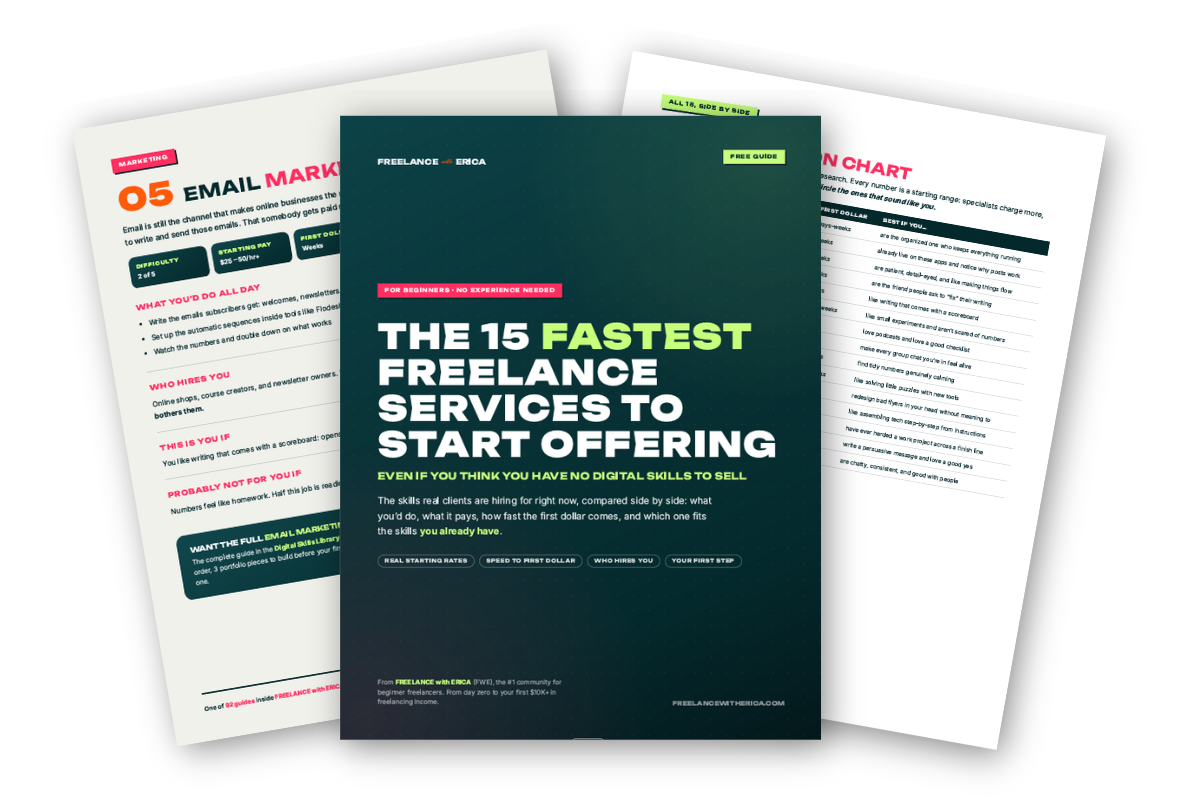
Get The 15 Fastest Freelance Services to Start Offering: all 15 compared side by side, with a clear read on which one fits the skills you already have.
📬 Go check your email!
Your free guide is on its way to your inbox right now. If it plays hide-and-seek, peek in the spam or promotions folder.
Level up later
Skills that stack with translation
The highest-earning freelancers combine two or three skills, so the same bilingual asset turns into multiple income streams.
Content Writing
Translation plus strong writing in the target language is transcreation: recreating content so it reads naturally, and it pays more than word-for-word translation.
Read the Guide →Language Tutoring & Interpretation
Your bilingual skill can earn a second income stream too. Many translators tutor or interpret to diversify and smooth out project gaps.
Read the Guide →Proofreading & Editing
Post-editing machine translation (MTPE) is a fast-growing service. Editing skill in your target language turns the AI shift into paid work.
Read the Guide →Freelance translation FAQ
How much do freelance translators make?+
Human translation commonly runs $0.10 to $0.30 per word, with general content around $0.08 to $0.15, and specialized legal or medical work $0.20 to $0.40 per word (regulated, rare-pair specialists reach $0.55). By the hour that's roughly $15 to $30 for beginners and $50 to $90+ for specialists. The cheap, machine-commoditized tier sits below this and isn't where you should compete. Where you land on these ranges depends on how you position yourself.
Do I need a degree to be a freelance translator?+
Not usually for general work, fluency and demonstrated quality matter more than a diploma, and many successful translators are self-taught bilinguals. But certified, legal, and medical translation often do require certification, a credential, or notarization authority, and that specialized work pays the most. The one non-negotiable requirement is genuine bilingual fluency. A degree is optional on top of that.
Can I be a translator if I only speak English well?+
Nope. This lane requires high-level fluency in at least two languages, ideally translating into your native or strongest one. Running text through machine translation isn't translation, and clients can tell immediately. If you're English-only, this isn't your lane, look at the other Library skills instead.
Is translation still a good freelance skill in the age of AI?+
Yes, with eyes open. Machine translation commoditized the cheap, "good enough" tier, so don't compete there. It made nuanced, specialized, and certified human work more valuable, and it created the growing post-editing (MTPE) market where fluent humans fix machine output. A translator who specializes and edits is still in real demand.
How do I get my first translation client?+
The fastest on-ramps are Upwork and translation-specific marketplaces like ProZ.com. Look for bounded jobs in your language pair, "translate this article," "localize these product pages," "proofread this Spanish translation," and deliver a clean sample as proof. Specialize early to stand out from the global generalist pool.
Get started, $9/mo
Ready to learn the how?
The full translation guide is one piece of the starting tier. Everything on the right comes with it.
- The full Digital Skills Library, all 90+ guides
- The Find Your Freelance Ready Skills training
- The FWE community chat forum
- Weekly co-working calls
- Five monthly contests for cash
- The monthly accountability challenge
- The proposal tracker that comes with it
- Live guest trainings