Where should you start freelancing? Let's narrow this down.
You decide you're going to try freelancing. Fabulous. Then you look up where to find clients and come back with seven websites, fourteen opinions, and somebody telling you that all of those websites are a terrible idea.
We haven't even applied for a job yet and already this is exhausting. 😅
Choosing the wrong starting place can cost you money and months of effort. So I'm going to walk you through the best and worst freelancing platforms for beginners in 2026, in the same order I cover them in my training. We'll start with the options, cross a few off, and then compare the two I'd keep on your list.
We're looking at Upwork, Fiverr, Freelancer, Guru, Contra, Toptal, PeoplePerHour, and finding clients off-platform. That last one isn't a website, but it comes up often enough that it deserves a spot in this conversation.
And when I say “worst,” I mean where I wouldn't send a complete beginner first. A place that works beautifully for someone with a portfolio and years of client relationships can be a frustrating place to start with none of those things.
First, I'd take Toptal and off-platform off your beginner list.
Toptal: let's get some experience before the entrance exam.
Toptal screens people for expertise. Its process includes skills assessments and test projects. It's built around experienced professionals who can demonstrate what they do.
If you're an established developer or designer, you may already have something to bring to that process. If you're still figuring out what you could sell as a freelancer, I wouldn't make that your first assignment.
Get some experience, build your portfolio, and collect the proof that you can do good work. You can come back to a platform like Toptal later. You don't need to get accepted into an expert network to be allowed to begin freelancing.
Off-platform: a good referral is different from starting from scratch.
If your neighbor owns a business and needs help with exactly the thing you offer, please go talk to your neighbor. I love a warm connection. We do not need to make that complicated.
But “just find your own clients” often leaves out quite a bit of the job description.
Now you're learning your service while also learning how to find leads, get their attention, have sales conversations, write contracts, invoice, and collect payment. Your tiny freelance business suddenly has six departments. All of them are you.
I tried finding clients off-platform when I first started. It was slow and frustrating. Things took off for me when I moved to a marketplace where clients were already looking for help.
Later, when you've got happy clients, testimonials, a portfolio, and people referring you? Finding work on your own becomes a different conversation. For now, I'd rather have you learning how to deliver your service than trying to build every part of the business at once.
Next: are there enough opportunities to get you hired?
One of the most frustrating parts of starting is trying to land those first jobs. You can be willing to work, excited to learn, and ready to get moving... and still need someone to give you a chance.
By the way, I run a beginner freelance community called FREELANCE with ERICA. If you're still trying to land your first clients, come check us out with a free 7-day trial. Helping beginners get through this part is what we do.
Freelancing is a numbers game. Not every proposal gets opened. Not every conversation turns into a job. So before you spend hours building a profile on a website, I want to know whether there are enough opportunities for you to keep showing up.
Here is the recording-day snapshot I shared in my September 10 training:
- Guru: fewer than 300 listings.
- Contra: fewer than 300 listings.
- PeoplePerHour: roughly 700 listings.
- Freelancer: about 5,000 listings.
- Upwork: more than 110,000 listings.
Those are the counts I reported when recording, not a live counter. Listings and filters change, and these aren't totals of beginner-only jobs.
What I'm looking at is the difference in the number of chances you have to find suitable work. Once you narrow by your skills, availability, and what you can confidently deliver, your list gets smaller. Starting with a tiny pool means it can get very small very quickly.
Fiverr works differently. Instead of browsing the same kind of job board, buyers shop for services freelancers have listed. Think Etsy for freelancing. That makes a job-listing count a poor way to measure the activity there.
For this beginner plan, I'd set Guru, Contra, PeoplePerHour, and Freelancer aside as primary starting places. You can explore them as supplemental options later, especially if you find a good pocket of work in your niche. I just wouldn't split your attention across all of them while you're trying to get your first client.
That leaves Upwork and Fiverr. Let's zoom in.
1. Active vs. passive: who makes the first move?
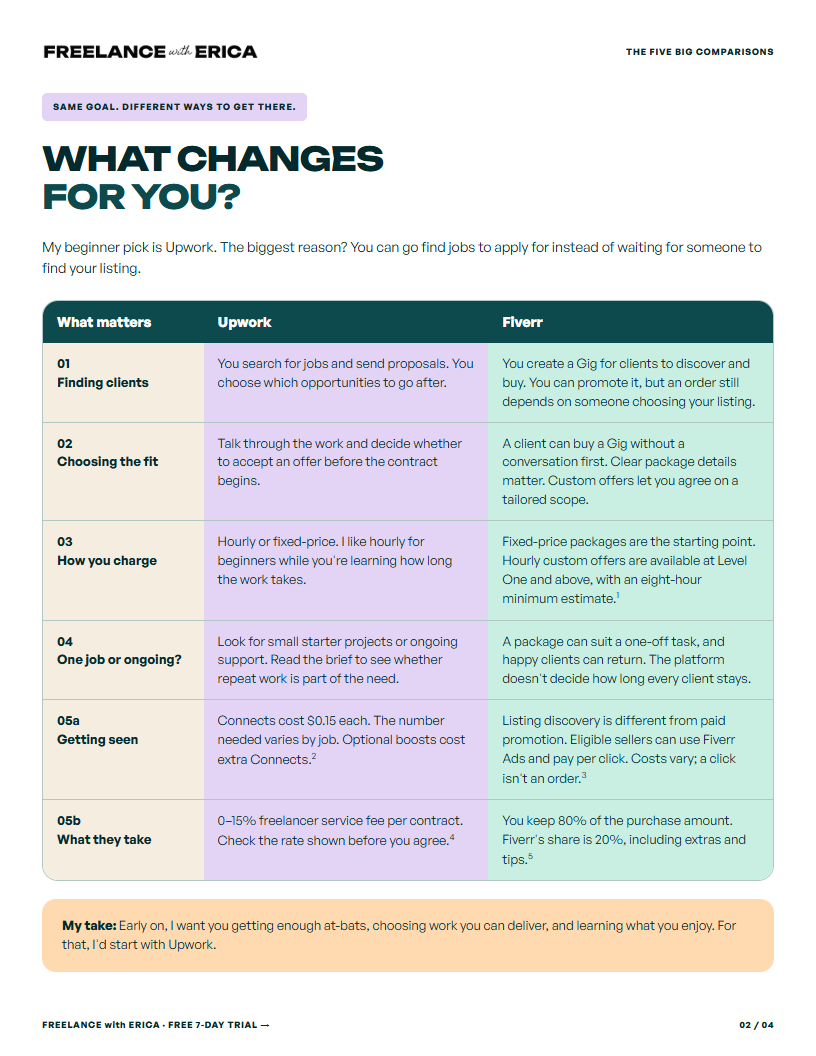
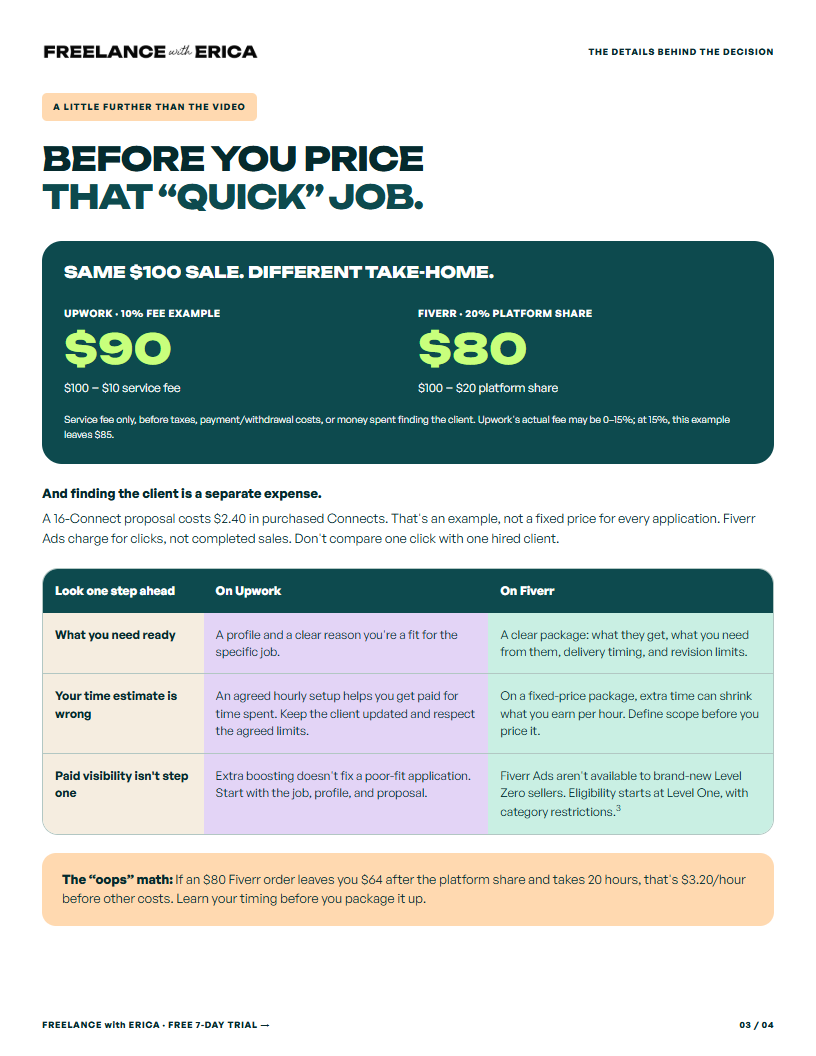
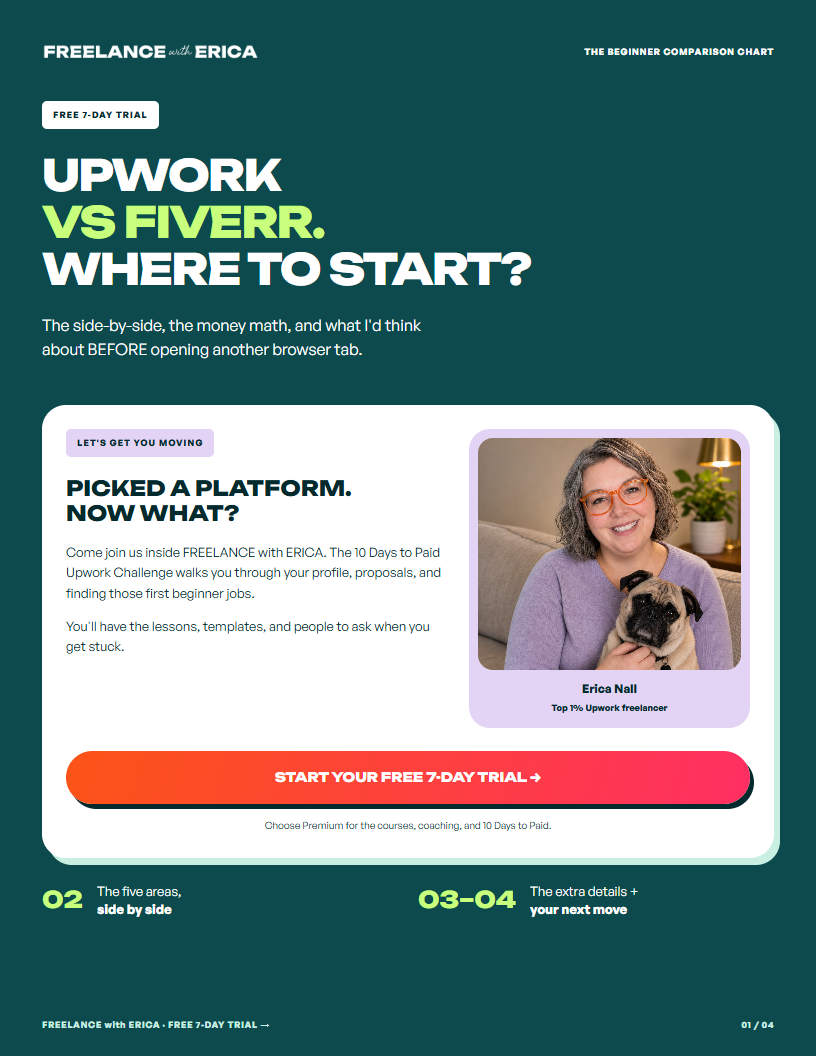
I'm going to compare these two platforms across five primary areas. I've also made a more in-depth free Upwork vs. Fiverr comparison chart you can keep beside you. It includes the side-by-side differences, fee examples, and a check for whether you're ready to package a service.
On Fiverr, you create your listing and hope the right person finds it and buys. You can work on the image, description, and visibility, but you're waiting for a buyer to come to you.
On Upwork, a client posts a job and you can apply. You can sit down today, find suitable jobs, and send proposals. You have an action you can take to get in front of more people.
That puts you more in the driver's seat when you're trying to land your first client. You can't make somebody hire you, but you don't have to wait for an algorithm to introduce you either.
Could you send 50 proposals? You could, if you found that many suitable jobs and had the time and budget. The point is that you have a way to create more opportunities. It isn't a recommendation to copy-paste the same paragraph into every listing with a pulse.
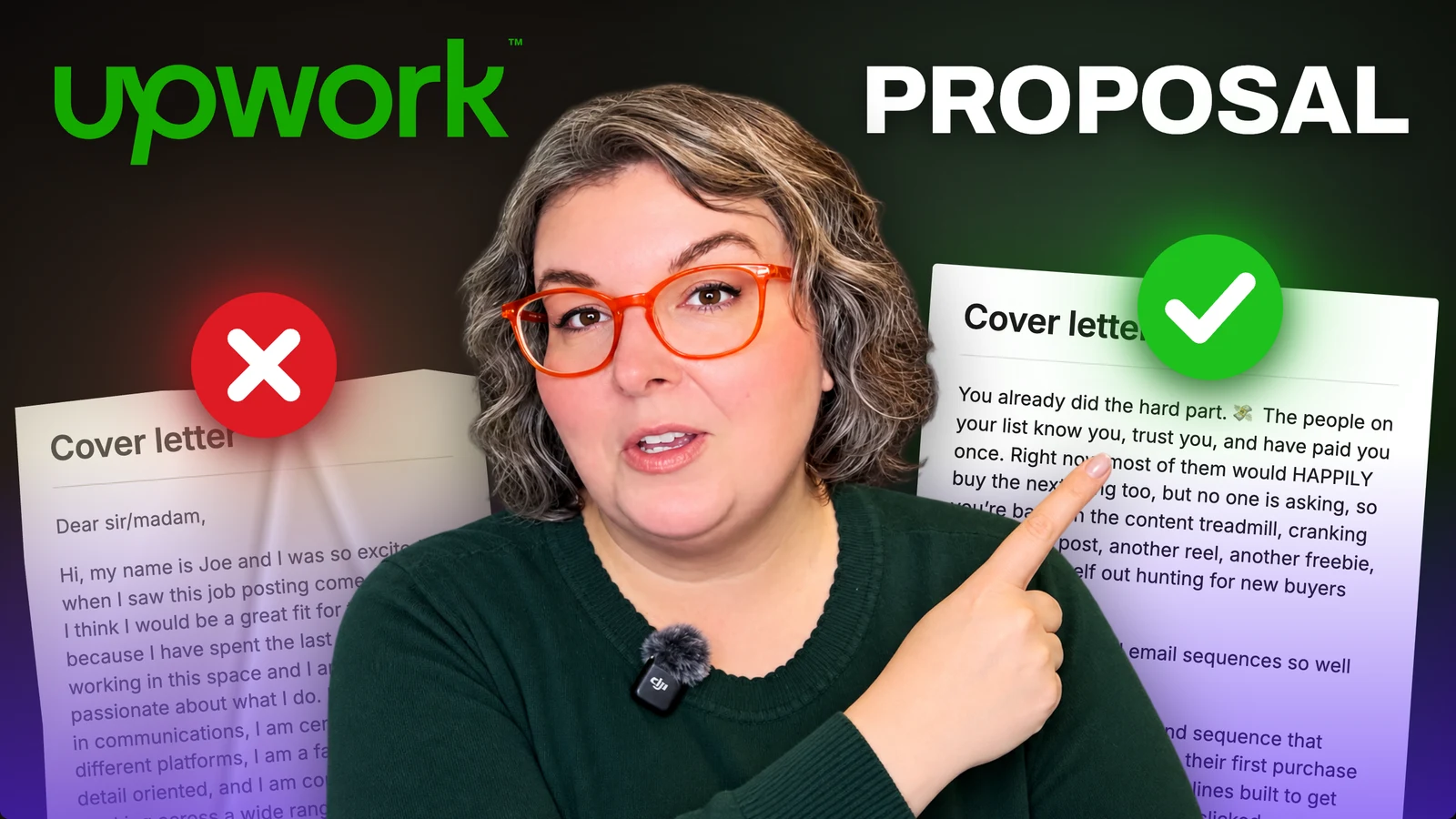
I teach you how to use those opportunities in my eight rules for writing Upwork proposals. Getting your application in front of someone and giving them a reason to open it work together.
2. Choosing your clients before you agree to the work
On Fiverr, a client can buy a Gig without speaking to you first. Convenient when the job is a good fit. Less delightful when you discover that “a few small changes” means redesigning their entire business before breakfast.
On Upwork, you can look at the client's history, read feedback, ask questions, and decide whether to accept the contract. You're choosing the job and the person you're working with.
I want beginners to have that conversation. What does the client need? What are they giving you to work with? What does “finished” look like? Those answers can tell you whether a project fits your current skills.
This matters for your reputation, too. It's harder to deliver a great experience when you and the client started with completely different ideas of what they bought. Your first few reviews are valuable. Give yourself a chance to understand the work before saying yes.
Fiverr does have custom offers and a paid Request to order feature for eligible sellers. But a conversation before every purchase isn't something I'd assume a brand-new seller has built in.
3. Hourly vs. flat fee: please learn how long the work takes.
Fiverr was built around selling a package for a set price, often with a few tiers. Upwork gives you both hourly and fixed-price contracts.
I like beginners working hourly as they start doing their chosen service.
You think the logo will take six hours. Then you spend twenty. Now you have a package people can keep buying at the same price, so you get to repeat that delightful discovery over and over.
We are not trying to invent a subscription to your own misery. 😅
I'd rather you get paid for the agreed work you're doing, track your time, and learn. How long does the first draft take? What happens during revisions? Which parts do you love, and which parts make you regret owning a computer?
Once you know those things, you can package a service from experience. You know what to include, what to charge, and how much work you're signing up for.
One current update worth knowing: Fiverr also offers hourly work, but it's available at Level One and above, with a minimum eight-hour estimate. That doesn't replace the package-pricing decision facing a new seller.
4. One-off jobs vs. clients who keep coming back
Fiverr lends itself to a transactional purchase: a buyer needs something specific, finds a package, and buys it. Upwork gives you a place to look for ongoing support, longer projects, retainers, and even contract-to-hire opportunities.
That doesn't mean every Fiverr client disappears after one order or every Upwork client becomes a retainer. But I want you thinking beyond the first payment.
If you enjoy email marketing support, for example, loading one newsletter can help you learn the client's software and preferences. If they send a newsletter every week, the need repeats. Getting familiar with their business can make you useful beyond that first task.
The platform spending figures also help explain why I pay attention to this. For the twelve months ending June 30, 2026, Upwork reported $5,230 in gross services volume per active client. Fiverr reported $368 in annual spend per buyer.
Those are annual platform spending measures, not the average value of one contract, and the companies define them differently. They give us some context, not a promise about what your next client will spend.
For your own business, I like the possibility of doing a small job well and growing into more work with that client. You don't have to leap straight into a giant retainer to start building toward one.
5. Fees: getting seen and getting paid are two different costs.
What does it cost to get in front of clients?
Upwork uses Connects, which cost $0.15 each. The number needed for a proposal varies. In my training, I used 16 Connects as an example: 16 × $0.15 = $2.40 to apply.
You can spend more on optional boosting, but submitting a proposal and boosting it are separate decisions. More spending doesn't automatically make the job a better fit.
On Fiverr, you can publish a Gig without paying for each application. Eligible sellers can also pay to promote listings through Fiverr Ads. That's pay-per-click advertising, with variable costs. A click doesn't mean a sale, just as a paid proposal doesn't mean a contract.
So yes, include the cost of finding work in your plan. Also include your time. Spending nothing while repeatedly refreshing a listing isn't necessarily the bargain it first appears to be.
What does the platform take from your work?
Upwork's freelancer service fee is 0% to 15% per contract, shown before you commit. Fiverr sellers receive 80% of the order amount, so the platform keeps 20%.
On $100 of work, that means $85 to $100 after Upwork's service fee, or $80 after Fiverr's. Application costs, advertising, taxes, and any other expenses are separate.
Look at what you keep, not just the number on the offer. Then think about how many hours the work will take you. A higher-priced package can still be a worse deal if it includes a mountain of extra work.
My recommendation: Upwork first. Fiverr once you know what to package.
After walking through all of that, Upwork is where I'd start as a beginner. You can actively apply, talk to clients before accepting, work hourly as you learn, and look for relationships that can grow.
Fiverr can be a great supplemental option once you're established. Get some experience. Build your social proof. Find the work you enjoy enough to do repeatedly. Learn how long it takes you to deliver it.
Then create the package. When an order comes in, fabulous. You've got an additional way for someone to hire you, instead of your entire bill-paying plan depending on whether a listing gets seen.
Everybody wants the passive sales stream. A lot of the people enjoying one put in plenty of active work before they got there. Right now, you may be in the part where you're showing up, applying, learning from client conversations, and building your reputation.
That reputation can help you move into more specialized work, get referrals, sell packages, or explore something like Toptal later. Your starting platform doesn't have to be your forever platform.
If you're ready for the next step, read how I teach beginners to land their first Upwork jobs with no reviews. You can work on those first experiences while learning your chosen service in the Digital Skills Library. Still figuring out what that service could be? Try my freelance skills quiz.
And if you'd like me to walk you through it, the 10 Days to Paid Upwork Challenge is inside my Premium community membership. It helps you get your profile established, start applying, and work toward your first clients and five-star reviews. Come check out FREELANCE with ERICA with a free 7-day trial. 🧡
A FEW QUICK ANSWERS
Before you open another tab…
Which freelancing platform should a beginner start with?
For the active approach I teach, I recommend Upwork first. The walkthrough compares eight starting options before explaining why I prioritize opportunities to apply, client conversations, and hourly work while learning.
Why not start on Toptal?
Toptal screens for established expertise. It can be worth exploring when you have relevant experience and proof, but it is not my recommended first stop for someone still learning a service.
Are the job counts current?
The counts in this article are the recording-day snapshot I shared on September 10, 2026. Listings and filters change; the figures are not live counts or totals of beginner-only jobs.
Can Fiverr be useful later?
Yes. Once you know what service you enjoy, how long delivery takes, and how to define its scope, Fiverr can provide another way for people to buy that service.

YOUR GUIDE · ERICA NALL
I’m an Expert-Vetted freelancer and sales copywriter. I teach beginners how to find their freelance skills, write stronger proposals, and start working with clients.
A little more about me ↗