Digital Skills Library · Legal
Can you freelance in immigration law?
The straight answer, real 2026 attorney rates ($75–400/hr for licensed immigration attorneys), and the three real on-ramps if you're drawn to this world but not yet a licensed attorney, plus the one boundary you must never cross.
Difficulty
5 of 5
Law degree and bar admission territory, you can't shortcut your way in
First dollar
N/A for non-lawyers
No fast path without the license; fast if you already have it
Startup cost
Very high
The real cost is law school and the bar exam, for the licensed path
AI-friendliness
High for attorneys only
Immigration rules shift constantly; AI states outdated rules with total confidence
Demand
Strong, but gated
Immigration work is steady and busy; the credential is the whole story
Start here
Get the real picture
This page shows you what freelance immigration law is like: the pay, the two real paths in, and whether it fits you, including the one boundary that matters more here than almost anywhere else in the Library. The full guide inside the Digital Skills Library splits cleanly in two: what applies if you're already a licensed immigration attorney, and what applies if you're not, so you know exactly which door is yours. Here's what unlocks for this guide:
- 🔒 The real split up front: what applies if you're a licensed immigration attorney, and what applies if you're not
- 🔒 Why unlicensed "help" here has a name, notario fraud, and how to stay clear of it entirely
- 🔒 The real on-ramp for non-lawyers: the three accessible immigration-adjacent lanes, no law degree required
- 🔒 Ready-to-use AI prompts for case-file organization, research memos, and client communication in the adjacent lanes
- 🔒 Which adjacent lane fits you, including the bilingual on-ramp, and how it grows into standing support income
- 🔒 The boundary toolkit: exact language for redirecting anyone who asks you for advice
- 🔒 The big-picture map: where this leads for a licensed attorney, and where it leads for everyone else
- 🔒 Updates whenever the immigration landscape and the market change
The skill, straight
What does an immigration lawyer do?
Immigration attorneys advise clients on their case, represent them before USCIS or in court, and decide the strategy a case runs on. This is the one legal area where well-meaning, unlicensed "help" can ruin a person's life, so the boundary around it is serious, backed by federal and state enforcement. There's no certificate or "I've helped a friend with their paperwork" version of this work.
01
Advise on an immigration case
Telling a client what they qualify for and how to proceed, putting a bar license and real legal liability behind the answer.
02
Represent clients before USCIS or in court
Appearing on a client's behalf, signing filings as their representative, deciding case strategy, work only a licensed attorney (or DOJ-accredited representative) can do.
03
Carry the risk a wrong answer creates
In immigration, a bad answer can cost someone their case, or worse. That's why the license isn't optional.
Is immigration law right for you?
Yes
You're a bar-admitted immigration attorney (or DOJ-accredited representative) who wants to freelance. The credential you already have is the whole game.
Maybe
You care about immigrants, maybe you're bilingual, maybe you've navigated the system yourself, and you want to help, but you don't have a law license. You can. As an immigration paralegal or document-prep support working under an attorney, you can do meaningful, well-paid work. You just can't be the one giving the advice.
No
You were thinking of setting up as an "immigration consultant" or "notario" to fill out forms for people directly. That is notario fraud. It's illegal, it's actively prosecuted, and it hurts the exact people you'd want to help. Do not.
Best for licensed immigration attorneys who want to freelance. For everyone else who cares, the paralegal and document-prep lanes are real, needed, well-paid work on their own merits.
Pick a lane
Immigration legal services you can sell
This splits hard by licensure, and in immigration the split matters more than anywhere else in the Library. Clients are buying a specific outcome for their case, or, if you're not licensed, the organization and research that gets an attorney there. The bright line, in one sentence: prepare, organize, research, and translate under an attorney's supervision, yes. Advise, represent, or decide, never.
Your Free Unlock
Get the full member version of this guide, free
Everything on this page is the short version. The member guide goes all the way: the step-by-step learning plan, the tools, the AI prompts, and the practice projects that build real skill. Every person gets one guide free, and it can be this one.
Unlock This Guide Free → One Free Guide Per PersonAlready unlocked a guide, or already a member? Log in here.
How the money grows
The reality ladder
One gated rung, and three real, accessible adjacent lanes, one of the most paralegal-heavy fields in all of law. These prices are market averages, and premium freelancers charge well beyond them.
Reality check
This rung is gated
Licensed attorneys only
Advising on immigration matters, representing clients before USCIS or in court, and deciding case strategy require a law license. There is no beginner version of this.
Adjacent (open to you)
Immigration paralegal / legal assistant
$45–125/hr+
Organizing case files, preparing forms for attorney review, gathering documents, tracking deadlines, all under attorney supervision.
Adjacent (open to you)
Legal research
$23–60/hr+
Researching immigration statutes, policy memos, and precedent for an attorney to interpret.
Adjacent (open to you)
Document prep & translation support
Varies
Assembling supporting documents and, if bilingual, translating them, never advising on the case itself.
Who hires for immigration law?
A surge in cases, a policy change that creates a filing rush, or a solo attorney with more clients than time. You've heard every one of these:
People hire a freelance immigration attorney the moment a case needs a licensed hand. Solo attorneys and legal-aid organizations are the biggest buyer of the adjacent lanes specifically: they have the license, they need reliable hands on the files. That's where a non-lawyer freelancer fits.
The numbers
How much do freelance immigration attorneys make?
If you're picturing yourself billing $75–400 an hour without a law degree, slow down. That number belongs to attorneys who are already bar-admitted. The ranges below are an example of what average freelancers charge on Upwork in 2026, and they're a good reference while you're starting out. Inside FREELANCE with ERICA, you'll learn how to position your services for premium pricing over time.
No degree needed
Not a from-zero lane
There's no realistic path here without a bar license or DOJ accreditation. The real entry point is immigration paralegal work, legal research, or bilingual document support.
Attorneys only
$75–200/hr+
A licensed immigration attorney building a freelance or part-time practice.
Advanced
$200–400/hr+
Reputation-driven work for licensed attorneys with a recognized specialty.
A bilingual immigration paralegal, in particular, is one of the more in-demand legal-adjacent freelancers there is. That's a real, well-paid lane, no law degree required.
One more thing, and I want you to really hear this: those ranges are averages, and averages have zero say over what you get to charge someday. As you work through my courses, you'll learn how to stack skills and position your services, so you can become a premium freelancer who charges above the market. Here's my own example: I'm a sales copywriter. Look up copywriters on Upwork and you'll see averages between $10 and $75 an hour. I regularly charge over $200 an hour for the same skill, because there are clients who happily pay for real expertise, and you only need a handful of them.
Free guide
Not sure this is your lane?
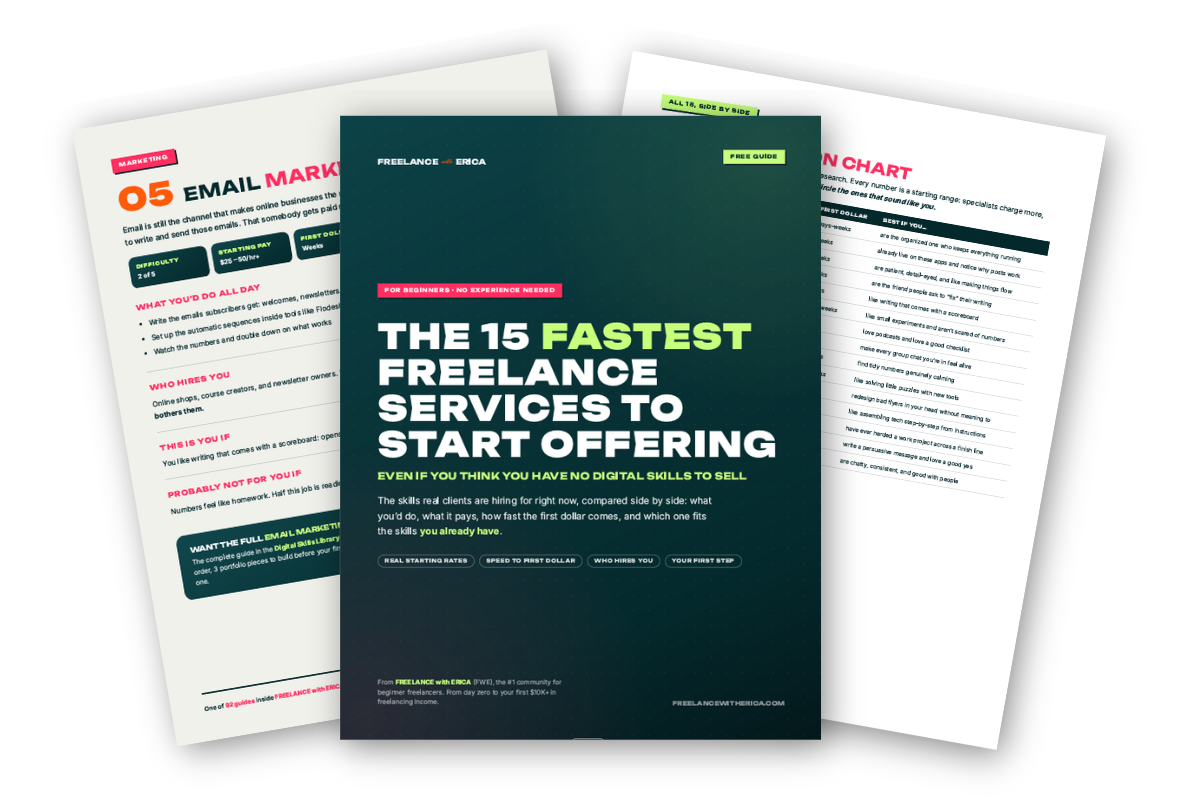
Get The 15 Fastest Freelance Services to Start Offering: all 15 compared side by side, with a clear read on which one fits the skills you already have.
📬 Go check your email!
Your free guide is on its way to your inbox right now. If it plays hide-and-seek, peek in the spam or promotions folder.
Level up later
The real adjacent lanes
If you're not licensed, one of these three is your actual freelance home. Each is a genuine, beginner-accessible lane with attorneys and legal-aid organizations hiring right now. Read the one that fits your temperament, or your languages.
Paralegal / Legal Assistant
Immigration is one of the most paralegal-heavy practice areas. Attorneys lean hard on paralegals for forms and file prep, real, accessible demand.
Read the Guide →Legal Research
Immigration policy changes constantly, so attorneys need ongoing research support. No law degree required.
Read the Guide →Translation & Localization
Bilingual document support is in heavy demand in immigration. If you speak another language, this stacks beautifully with paralegal work.
Read the Guide →Freelance immigration law FAQ
Can I help people with their immigration paperwork without being a lawyer?+
Only under an attorney's supervision, and only as preparation, never advice. You can organize files, gather documents, and prepare forms for an attorney to review and sign. You cannot decide what to file, tell someone what they qualify for, or act as their representative. Doing that without a license is notario fraud, which is illegal and actively prosecuted.
What is notario fraud and why does it matter so much here?+
In many cultures a "notario" is a trained legal professional, so unlicensed "immigration consultants" in the U.S. have exploited that confusion to charge vulnerable people for "help" that's the unauthorized practice of law, often wrecking their cases. It's a top enforcement priority. The lesson: stay strictly in supervised support work. Never advise.
I'm bilingual and want to help immigrants. What's the real lane?+
Immigration paralegal or document-translation support, working with a licensed attorney or legal-aid org. Your language skills are in demand there, and you'll be doing meaningful, well-paid, legal work, without crossing the line.
If I'm a licensed immigration attorney, is freelancing worth it?+
Yes. Immigration work is steady and the field is busy. Freelance and part-time arrangements with firms and legal-aid orgs are real and growing. Your license is the moat.
Can AI help me give people immigration answers faster?+
No, and this is important: immigration rules change constantly, and AI frequently states outdated or wrong rules with total confidence. Even for licensed attorneys, AI is a research aid, never the source of truth. For non-lawyers, using AI to "answer" immigration questions for people is both dangerous and the unauthorized practice of law. Don't.
Get started, $9/mo
Ready for the full breakdown?
The complete immigration law guide is one piece of the starting tier. Everything on the right comes with it.
- The full Digital Skills Library, all 90+ guides
- The Find Your Freelance Ready Skills training
- The FWE community chat forum
- Weekly co-working calls
- Five monthly contests for cash
- The monthly accountability challenge
- The proposal tracker that comes with it
- Live guest trainings